UK Uncut says arrests were political
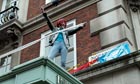
Campaign group claims police are trying to disband it following arrests at Fortnum and Mason sit-in Protest group UK Uncut signalled its intention to continue occupying high street stores as police released images of individuals wanted in connection with violent disorder. A spokesman for the tax avoidance campaigners insisted they would not be cowed, despite concerns that the Met is intent on disabling the group’s command structure and has “politically targeted” its ringleaders. The Met has charged 138 people – practically the movement’s entire leadership – with aggravated trespass after a UK Uncut occupation of Fortnum & Mason in central London during the anti-cuts march. A meeting of UK Uncut supporters heard that those charged have had their phones confiscated. The mobiles contain details of the group’s secure networks and email accounts used to mobilise and organise its actions. The group believes the decision to charge all those inside Fortnum & Mason was an attempt by police to crush the movement. Only two of its chief ringleaders were outside the store at the time. “Practically the entire UK Uncut was inside, but it’s definitely not the end of that tactic because most people can see that this is political policing,” said the spokesman. The group is baffled why Scotland Yard, which rejects claims of politically motivated policing, decided to charge its members while previous peaceful occupations had seen officers take no action. Video evidence reveals a senior police officer assuring protesters on the day that they would not be detained upon leaving the store. Meanwhile, Scotland Yard has released 18 images of protesters, unconnected to UK Uncut, that they are keen to identify in the wake of the disorder. The investigation, Operation Brontide, is expected to publicise more images, mainly from CCTV. The Met is eager to disrupt those engaged in “black bloc” tactics, and is believed to have footage showing anarchists removing black clothing, bandanas and scarves before changing into civilian gear to evade detection. Detective chief superintendent Matthew Horne, leading Operation Brontide, said: “A significant minority came to London to cause violence and damage. There is an extensive operation to identify these people.” Fresh claims of politically motivated policing have also surfaced in a report alleging that officers prevented Muslims from attending counter demonstrations against a major English Defence League rally. Leicester constabulary operated a policy of stopping elements of the Muslim community protesting against the EDL during a high-profile march in the city last October, according to the Network for Police Monitoring (Netpol). It said that the force attempted to dissuade Muslims through mosques and schools from protesting against the EDL demonstration at an authorised protest by Unite Against Fascism (UAF) on the same day, and issued leaflets advising that young people could be picked up and held in “safe areas”. Val Swain of Netpol said: “This is a strategy that we have seen up and down the country, and it appears to have been sanctioned at the highest levels. “The way in which the police are interfering in communities to deter people from organising and participating in lawful, legitimate protest is deeply disturbing. It is not for the police to decide which sectors of society are allowed to protest and which are not.” Saqib Deshmukh, a youth worker in the East Midlands, said it appeared that officers were willing to facilitate the EDL’s right to protest at the expense of the Muslim community, adding: “Certain groups of people are being denied the right to protest. It seems that the government is far more worried about the mobilisation of Muslim people than they are about the EDL.” Police in Lancashire adopted another tactic, imposing a limit of 3,000 on both an EDL march and one by counter-demonstrators in Blackburn to reduce the possibility of violence. The report by Netpol claims the reaction by Leicester constabulary could breach articles 10 and 11, the freedom of assembly and expression, of the European convention on human rights. It also reveals widespread disquiet over why the EDL was allowed to congregate in city centre pubs before the march and move close to Muslim areas. One community worker described their treatment as a “policy of appeasement”. The Leicester force has previously stated that it adopted polices to reduce the risk of public disorder and that it engaged with the Muslim community and acted in its interests. UK Uncut Police Protest Public sector cuts Mark Townsend guardian.co.uk

 Posted by
on April 2, 2011. Filed under News, Politics, World News.
You can follow any responses to this entry through the RSS 2.0.
You can skip to the end and leave a response. Pinging is currently not allowed.
Posted by
on April 2, 2011. Filed under News, Politics, World News.
You can follow any responses to this entry through the RSS 2.0.
You can skip to the end and leave a response. Pinging is currently not allowed.