Obama sanctions use of Predator drones in Libya
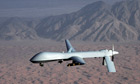
Senior Nato military commanders have been pressing for the unmanned planes to strike Gaddafi forces in besieged Misrata The US has approved the use of missile-armed Predator drones to help Nato target Colonel Gaddafi’s forces in Libya. Coalition commanders have been privately urging the Americans to provide the specialist unmanned aircraft, which have become a favoured – if controversial – weapon in Afghanistan and Pakistan. Their ability to hone in on targets using powerful night-vision cameras is considered to be one way of helping rebels in the besieged city of Misrata, where a humanitarian crisis has unfolded in the last week. The US defence secretary, Robert Gates, said Barack Obama had approved the use of the Predators, marking a re-escalation of the US contribution to the Nato effort. Gates told a Pentagon news conference that the Predator was an example of the unique US military capabilities that the president is willing to contribute while other countries enforce a no-fly zone. General James Cartwright said that the first Predator missionin Libya had been scheduled for Thursday night but was abandoned due to poor weather. Liam Fox, the British defence secretary, and Sir David Richards, the chief of the defence staff, are due in Washington next week to discuss the situation in Libya with Gates and Mike Mullen, the chairman of the joint chiefs of staff. The use of Predators is one of the topics to be discussed at the Pentagon talks next Tuesday, as well as other specialist equipment that might be provided by the US. David Cameron has again insisted that Nato had no intention of deploying ground troops, but this did not mollify Russia. It condemned the sending of military advisers to Libya by the UK and France, saying this exceeded the mandate of UN security council resolution 1973. “We are not happy about the latest events in Libya, which are pulling the international community into a conflict on the ground,” said the Russian foreign minister, Sergei Lavrov. “This may have unpredictable consequences.” However, senior Whitehall officials believe the use of drones, also known as UAVs, would not be beyond the remit, or the spirit, of the UN resolution which gave the coalition a mandate to protect civilians. “A UAV with sufficiently high-resolution sensors, were it armed, could fire that weapon in line of sight and still meet the tight rules of engagement,” a military source said. “We have been asking if we can get the US to provide that capability for us. It exists – the question is can we get it to be deployed? UAVs would give you speed of response where you see the regime transgressing the UN resolution,” the source said. The US is understood to have the UAVs in the region already. A Whitehall source said of Tuesday’s talks: “Part of the discussion will be whether there are any niche capabilities that can be used. UAVs are a part of that and the US has expertise in this area. We are focusing a lot of targeting around Misrata and we need to explore what other capabilities we can use.” The UN secretary general, Ban Ki-Moon, urged Gaddafi to “stop killing people”, and estimated that 500,000 Libyans had now fled the country. The MoD also sought to counter criticism that Nato is not doing enough for Misrata, saying that the RAF had hit 58 targets around the city in the past three weeks, including 37 main battle tanks. But officials also concede that the difficulties of targeting within the city are considerable. Earlier this week Nato’s commander, Lt Gen Charles Bouchard, described the situation within Misrata as being akin to “a knife fight in a phone booth”. He said Gaddafi forces were hiding on the rooftops of mosques, hospitals and schools, and that they were shielding themselves behind women and children. The military difficulties were underlined when further details emerged of the death of British photographer Tim Hetherington, who was killed on Wednesday in a mortar attack along with a colleague, Chris Hondras. An Oscar-nominated film-maker, Hetherington, 41, wrote in his last Twitter post on Tuesday: “In besieged Libyan city of Misrata. Indiscriminate shelling by Gaddafi forces. No sign of Nato.” His family issued a statement through Vanity Fair, who had hired him on assignment in Libya. “Tim will be remembered for his amazing images and his Academy Award-nominated documentary Restrepo, which he co-produced with his friend Sebastian Junger. He will be forever missed,” the family said. Vanity Fair editor Graydon Carter said Hetherington was “about as perfect a model of a war photographer as you’re going to find these days”. Libya Nato Barack Obama Arab and Middle East unrest US foreign policy United States Middle East David Cameron Foreign policy Defence policy Tim Hetherington Documentary Nick Hopkins guardian.co.uk

 Posted by
on April 21, 2011. Filed under News, Politics, World News.
You can follow any responses to this entry through the RSS 2.0.
You can skip to the end and leave a response. Pinging is currently not allowed.
Posted by
on April 21, 2011. Filed under News, Politics, World News.
You can follow any responses to this entry through the RSS 2.0.
You can skip to the end and leave a response. Pinging is currently not allowed.