Ivory Coast prepares for showdown
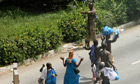
Four days of fighting have stopped Ouattara supporters’ rapid advance and prompted UN to evacuate civilian staff The UN has evacuated civilian staff from its base in Ivory Coast as thousands of rebel troops gather outside Abidjan for what looks set to be a bloody final offensive. France took control of the city’s airport and bolstered its military presence, fuelling president Laurent Gbagbo’s hostile rhetoric against foreign “occupation”. The heightened tensions came as Alassane Ouattara, winner of last November’s presidential election, denied UN accusations that his forces were responsible for a massacre of hundreds of civilians in a western village. The UN evacuation followed four days of attacks on its headquarters and patrols by Gbagbo’s republican guard. Eleven peacekeepers have been injured in two days, including four on Saturday when Gbagbo’s forces fired a rocket-propelled grenade at a UN armoured personnel carrier. The office of the chief of the mission has also been targeted. One UN employee was killed by a stray bullet last week. The UN flew about 170 civilian staff to the rebel-held city of Bouake, where it began expanding its logistical base after Gbagbo’s regime stepped up anti-UN propaganda and tried to cut off fuel and food supplies to the UN headquarters. The coming days could witness a conclusive battle for Abidjan. Thousands of pro-Ouattara troops amassed on the northern edge of the city. An adviser to Ouattara, who did not wish to be named, said they are preparing for a final push to depose Gbagbo. But after swiftly taking control of swaths of the country, pro-Ouattara forces have met fierce resistance in Abidjan over the past four days. Gbagbo troops have held on to positions around the presidential palace, Gbagbo’s residence and state TV buildings. The president’s forces could be seen regrouping on Sunday. Boatloads of young men were ferried into the centre of the city and marched the streets, carrying rudimentary weapons such as pieces of two-by-four wood and metal bars. Hundreds answered Gbagbo’s call to form a human shield around his residence. “There was an attack planned on the presidential residence, but it didn’t happen, possibly because of the human shield around it,” a western diplomat told Reuters. “But it seems to have started up again. I’m hearing some booms from the direction of RTI [state TV].” French troops moved to secure Abidjan’s international airport. Several French cargo planes arrived with 300 soldiers to reinforce the mission, said Commander Frederic Daguillon of the French force, which is now around 1,400 strong. Gbagbo’s state TV accused the French troops of preparing a genocide like that in Rwanda in 1994 in which more than 800,000 people were killed. A caption onscreen read: “[French president Nicolas] Sarkozy’s men are preparing a Rwandan genocide in Ivory Coast. Ivorians, let us go out en masse and occupy the streets. Let us stay standing.” More than 1,650 foreigners – including about 700 French nationals and 600 Lebanese – are sheltering in a French army camp. Sarkozy held an emergency two-hour meeting in Paris to discuss the crisis. Residents of Abidjan braved sporadic shooting and ventured out to pray, get water and buy food after being trapped in their homes during three days of intense fighting. “Many people went to church to pray to God to stop the war in the country,” Sylvie Monnet, a resident of the Yopougon neighbourhood, told Reuters. But the frightening sight of armed young men roaming the streets kept many others locked indoors. A resident of the densely populated neighbourhood of Koumassi told how he had peered out of a window to see a small group of young men wearing jeans and T-shirts and nonchalantly carrying Kalashnikov rifles. “I have seen guys in military uniform, and I think that our neighbourhood is controlled by the invisible commando,” he said, referring to an anti-Gbagbo group that has seized control of some parts of Abidjan. But if they wear civilian clothing, you can’t tell whether they are pro-Gbagbo or pro-Ouattara. It’s unsettling. I voted for Ouattara, but I really do not appreciate this.” Ethnic tension seemed to increase by the day, he said. “There is so much mutual distrust. There is a feeling that the situation can explode any moment.” Some had little choice but to venture out. Pamela Somda, a student, said: “We have nothing more to eat at home. I have just a single fresh fish at home and after that, I do not know what to do. It is really difficult.” Small grocery shops were running out of staples such as eggs, sardines and stock cubes, and prices had soared for the available food. Electricity has been cut intermittently and water was shut off across the city on Sunday morning, although a few women could be seen on the street filling basins with water from the lagoon. Meanwhile Ouattara has clashed with the UN over claims that his forces were involved in a massacre of hundreds of civilians, an allegation that threatens to tarnish his credentials as the democratically elected, internationally supported leader. The UN mission said traditional hunters, known as Dozos, fought alongside Ouattara’s forces and took part in killing 330 people in the western town of Duekoue. The International Committee of the Red Cross said at least 800 people were killed in intercommunal violence in Duekoue last week. It is not clear whether that 330 is included in the larger figure. Guillaume Ngefa, deputy head of the human rights division of the UN mission in Ivory Coast, blamed 220 of the deaths on pro-Ouattara forces. He told France24 TV that the killings happened between Monday and Wednesday as pro-Ouattara troops advanced south. Pro-Gbagbo militias killed more than 110, he added. Ouattara’s camp hit back and blamed the UN. His justice minister, Jeannot Ahoussou-Kouadio, accused the nearly 1,000 peacekeepers based in Duekoue of abandoning the town and leaving civilians at the mercy of vengeful Gbagbo fighters. “The government notes that the [UN mission] retreated from the town of Duekoue before its liberation by the Republican forces at the same time that the town was prey to looting and exactions of every type being committed by the militia and mercenaries of Mr Laurent Gbagbo,” he said. The UN said most of its soldiers were deployed around a Catholic mission, protecting 15,000 people who had sought refuge there. The mood remained tense as Red Cross workers dug a mass grave. An inhabitant of Duekoue said bodies were lining the streets near the neighbourhood Carrefour, which he said was targeted by Ouattara’s forces on Tuesday. Carrefour was known as a neighbourhood “where you could only enter if you were a Guere”, he said, referring to an indigenous western tribe that is fiercely pro-Gbagbo. It also harboured armed militias and Liberian mercenaries who regularly set up roadblocks to extort money from passing trucks and taxis and harass immigrants. “When [Ouattara's] republican forces seized the town, they surrounded the area and killed all the men they suspected of being militias,” said the man, who wished to remain anonymous. “The UN is patrolling here now and aid workers are trying to collect the bodies. You can see piles of 10 bodies here, 20 there, or just one or two lying around. I can’t tell you exactly how many I’ve seen, but I would guess up to 200.” The total number of people killed since the presidential election in November is now more than 1,300. Ivory Coast France Laurent Gbagbo Alassane Ouattara Refugees David Smith Kim Willsher guardian.co.uk

 Posted by
on April 3, 2011. Filed under News, Politics, World News.
You can follow any responses to this entry through the RSS 2.0.
You can skip to the end and leave a response. Pinging is currently not allowed.
Posted by
on April 3, 2011. Filed under News, Politics, World News.
You can follow any responses to this entry through the RSS 2.0.
You can skip to the end and leave a response. Pinging is currently not allowed.