Gaddafi regime starts talks with the west to end conflict
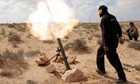
Rebels offer ceasefire as doctor says seven civilians have been killed in an air strike The regime of Muammar Gaddafi has initiated a concerted effort to open lines of communication with western governments in an attempt to bring the conflict in the country to an end. Libya’s former prime minister Abdul Ati al-Obeidi told Channel 4: “We are trying to talk to the British, the French and the Americans to stop the killing of people. We are trying to find a mutual solution.” As rebel leaders offered a ceasefire if Gaddafi withdraws his military from Libya’s cities and permits peaceful protests, senior British sources said they were open to dialogue. “If people on the Gaddafi side want to have a conversation we are happy to talk,” one said. “But we will deliver a clear and consistent message: Gaddafi has to go and there has to be a better future for Libya.” The signals came after the Guardian reported that a meeting had taken place between Mohammed Ismail, a senior aide to Gaddafi’s influential son Saif al-Islam, and British officials on Wednesday in London. Ismail is a key fixer who has been used by the Gaddafi family to negotiate arms deals and has considerable contacts in the west. Ismail and Moussa Koussa, the Libyan foreign minister who defected to Britain on Wednesday night, are not the only present and former supporters of the regime to have been in contact with Britain. British officials have been in contact with a number of Libyan officials in recent weeks in behind-the-scenes diplomacy, according to a spokesman for David Cameron. He stressed that Britain had not been involved in negotiating any possible trade-offs aimed at sealing Gaddafi’s exit from power. “There are no deals.” The disclosure of the dialogue came as the revolutionary leadership in the east laid down conditions for a ceasefire after a visit by the UN’s special envoy Abdelilah al-Khatib to the rebel capital, Benghazi. “We agree on a ceasefire on the condition that our brothers in the western cities have freedom of expression and also that the forces that are besieging the cities withdraw,” said one of the leadership, Mustafa Abdul Jalil. “Our aim is to liberate and have sovereignty over all of Libya.” The rebels’ initiatives were announced as the first credible report of civilian casualties from the western air campaign emerged. Suleiman Refadi, a doctor who has worked with the rebels, told reporters that seven civilians, including three girls from the same family aged 12 to 16, were killed on Wednesday in an air strike. Refadi said the victims also included three youths and a fourth girl when missiles hit a government ammunition lorry and destroyed two houses about nine miles from Brega and what is now the front line. About 25 people were injured. The report was not independently confirmed. In Tripoli, gunfire was heard near Gaddafi’s compound. Reuters reported that residents said they saw snipers on rooftops and pools of blood on the streets. The rebels made it clear that their talk of a ceasefire should not be seen as a sign of weakness. In an attempt to finally bring order to its chaotic military campaign, the leadership introduced the first of its newly trained troops toward Brega, which was seized by the government earlier this week, and hauled up rocket launchers. They were also seen to have communications equipment which the leadership was appealing to foreign governments to provide just a few days ago. The newly uniformed soldiers included officers who, the rebels said, would establish lines of command to end shambolic confrontations in which revolutionaries have only been able to move forward under the cover of western air strikes and have been unable to hold ground. While the rebels prepared for a new offensive in the east, Gaddafi’s forces launched a fresh assault on Misrata, the last enclave in the west still under the revolutionaries’ control. Libya’s third largest city was hit with tank and artillery fire. “It was random and very intense bombardment,” a spokesman, called Sami, told Reuters by telephone. “We no longer recognise the place. They are targeting everyone, including civilians’ homes.” Libya Muammar Gaddafi Arab and Middle East unrest Middle East Peter Beaumont Chris McGreal Nicholas Watt guardian.co.uk

 Posted by
on April 1, 2011. Filed under News, Politics, World News.
You can follow any responses to this entry through the RSS 2.0.
You can skip to the end and leave a response. Pinging is currently not allowed.
Posted by
on April 1, 2011. Filed under News, Politics, World News.
You can follow any responses to this entry through the RSS 2.0.
You can skip to the end and leave a response. Pinging is currently not allowed.