Deadly tornadoes hit southern US states
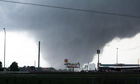
Storms kill more than 100 in Alabama alone, with Tuscaloosa and Birmingham reporting deaths and large-scale damage Powerful storms tore through several southern American states overnight killing at least 128 people in Alabama alone. Fifteen people died in Tuscaloosa, a city of 93,000 and home to the University of Alabama. Sections of the city were destroyed and the city’s infrastructure devastated, the mayor said, after a tornado hit the area. A statement from the Alabama governor, Robert Bentley, on Thursday, said the damage was spread over a wide area, flattening buildings, ripping down trees and power lines and triggering floods. Further north, a nuclear power plant west of Huntsville lost power and was operating on diesel generators. In Mississippi, 11 deaths were reported, four people were killed in Georgia and one in Tennessee. In Tuscaloosa, news footage showed paramedics lifting a child out of a flattened home, with many neighbouring buildings reduced to rubble. A hospital said its emergency room had admitted about 100 people, but had treated 400. “What we faced today was massive damage on a scale we have not seen in Tuscaloosa in quite some time,” Mayor Walter Maddox told reporters, adding that he expected his city’s death toll to rise. “This could be the worst tornado in Alabama’s history,” said meteorologist Josh Nagelberg of AccuWeather.com . The storms spread destruction from Tuesday night and Wednesday from Texas to Georgia, and it was forecast to hit the Carolinas before moving further north-east. Several states suffered power outages as well as property and infrastructure damage that could prove costly to repair. Floods were a concern throughout the storm-hit area, where rain compounded with melted snow to cause rising rivers and saturated soils. The storms forced the Tennessee Valley Authority to close three nuclear power plants in Alabama and knocked out 11 high voltage power lines. President Barack Obama said he had spoken to Bentley and approved his request for emergency federal assistance, including search and rescue assets. “Our hearts go out to all those who have been affected by this devastation, and we commend the heroic efforts of those who have been working tirelessly to respond to this disaster,” Obama said in a statement. Around Tuscaloosa, traffic was hampered by fallen trees and power lines, and some drivers abandoned their cars. Maddox said authorities were having trouble communicating with each other as 1,400 National Guard soldiers were deployed around the state. The flashing lights of emergency vehicles could be seen on darkened streets all over town, and some were using winches to remove overturned vehicles from the side of the road. Storms struck Birmingham earlier in the day, bringing down numerous trees that impeded emergency crews and those trying to flee. Surrounding Jefferson county reported 11 deaths by late Wednesday; another hard-hit area was Walker county with eight deaths. The rest of the deaths were scattered around the state, emergency officials said. In Huntsville, meteorologists found themselves in the path of tornado and had to evacuate the national weather service office. In Mississippi, a police officer was killed on Wednesday morning when a tree fell on to his tent as he shielded his young daughter with his body, said Kim Korthuis, a ranger with the National Park Service. The girl wasn’t hurt. By late Wednesday, the state’s death toll had increased to 11 for the day, said the authorities. The governor also made an emergency declaration for much of the state. Storms also killed two people in Georgia and one in Tennessee on Wednesday. In eastern Tennessee, a woman was killed by falling trees in her trailer in Chattanooga. Just outside the city in Tiftonia, what appeared to be a tornado also struck at the base of the tourist peak Lookout Mountain. Tops were snapped off trees and insulation and metal roof panels littered the ground. United States Alabama Natural disasters and extreme weather State of Georgia Tennessee Mississippi Mark Tran guardian.co.uk

 Posted by
on April 28, 2011. Filed under News, Politics, World News.
You can follow any responses to this entry through the RSS 2.0.
You can skip to the end and leave a response. Pinging is currently not allowed.
Posted by
on April 28, 2011. Filed under News, Politics, World News.
You can follow any responses to this entry through the RSS 2.0.
You can skip to the end and leave a response. Pinging is currently not allowed.