Ukraine raises $785m to seal reactor under new ‘shell’
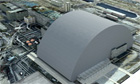
World governments pledge millions for the construction of a 20,000-tonne steel arch to prevent further radiation leaks Governments from around the world today pledged $785m (€550m) to seal the stricken nuclear reactor at Chernobyl within a 20,000-tonne steel shield that would be large enough to enclose St Paul’s Cathedral in London. The huge arch is designed to prevent any further radiation from escaping for 100 years. The pledges, made at a conference in Kiev ahead of the 25th anniversary of the disaster on 26 April 2011, bring the total raised for the Chernobyl safety works to $1.8bn and will enable efforts to finally secure the reactor which caught fire in April 1986. Twenty-eight governments have so far offered money. The European commission was the biggest contributor with €110m. The US pledged €86m and Britain – which still has more than 300 hill farms in Wales under radiation restrictions following fallout from Chernobyl – will contribute €35m. The European Bank for Reconstruction and Development announced an extra €120m. Japan, Italy and Canada are considering whether to contribute to the fund. The planned arch-shaped structure, which at 190 metres (623 feet) wide and more than 100 metres tall, will take five years to build. It will replace a hastily built concrete “sarcophagus” erected around the reactor in 1987. This now has serious cracks in it, raising fears that 95% of the original nuclear material which is left inside the reactor could escape. Radiation levels directly over the sarcophagus are too high for the arch to be built over it, so it will be constructed in two halves and then moved over it on rails. It is designed so that authorities could start dismantling the reactor from inside in 100 years’ time. The shield is intended to stay in place until either the radiation threat decreases or the Ukrainian government finds a permanent storage facility for the 200 tonnes of uranium and one tonne of radioactive plutonium still inside the ruins. World governments, which had already raised more than €1.1bn in international funding for the shelter, as well as for a permanent nuclear fuel store for other reactors on the Chernobyl site, said that the current crisis in at the Fukushima plant in Japan persuaded them to respond to the appeal by Ukraine, which estimates the accident has so far cost the nation more than $12bn. “Recent events in Fukushima, Japan, have reminded us of the danger this issue may represent,” said European commission president, José Manuel Barroso. The French prime minister, François Fillon, said Fukushima evoked memories of Chernobyl: “More than ever our responsibility is to join together our efforts to limit the consequences of such disasters and to prepare for the future.” But Mikhail Gorbachev, president of the Soviet Union at the time of the Chernobyl disaster and now head of the environment group Green Cross International , used the occasion of the 25th anniversary to say nuclear power was not the answer to the world’s energy problems or to climate change. “Nuclear power has been presented as a financially sound, economically efficient, clean and safe solution that will bring about energy security and drive economic growth. Recently, the so-called ‘nuclear renaissance’ has hitched a free ride on the back of the need to find low-carbon solutions to the climate crisis. The bottom line on the economics of nuclear power is that it simply does not add up. That is why private investment is wisely focusing on better alternatives,” he said in a statement. “It is necessary to realise that nuclear power is not a panacea, as some observers allege, for energy sufficiency or climate change. Its cost-effectiveness is also exaggerated, as its real cost does not account for many hidden expenses. In the United States, for example, direct subsidies to nuclear energy amounted to $115bn between 1947 and 1999, with an additional $145bn in indirect subsidies. In contrast, subsidies to wind and solar energy combined over this same period totalled only $5.5bn. But Mohamed ElBaradei, former head of the International Atomic Energy Agency, said: “Today, nuclear power is the only real alternative to fossil fuel as a source of a reliable supply.” He acknowledged that confidence in atomic energy has taken a severe blow after the tsunami-triggered disaster at Fukushima. “Fukushima represents a potentially significant setback for nuclear power,” he told participants at the forum, although he stressed that confidence will be “re-established in due course”. “Chernobyl and Fukushima should be shown to be aberrations,” he said. Chernobyl nuclear disaster Nuclear power Ukraine Europe John Vidal guardian.co.uk

 Posted by
on April 19, 2011. Filed under News, Politics, World News.
You can follow any responses to this entry through the RSS 2.0.
You can skip to the end and leave a response. Pinging is currently not allowed.
Posted by
on April 19, 2011. Filed under News, Politics, World News.
You can follow any responses to this entry through the RSS 2.0.
You can skip to the end and leave a response. Pinging is currently not allowed.