Misrata attacks kill 10 civilians
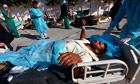
Photographers Tim Hetherington and Chris Hondros are among those killed in latest attacks on rebels’ western stronghold Misrata, the besieged rebel stronghold in western Libya, has come under heavy mortar fire, killing at least 10 civilians and leaving more than 100 injured, according to medical staff. Among those killed were Tim Hetherington, a British-born photographer and Oscar-nominated documentary director, and Chris Hondros, a US photographer for Getty Images . Seven Libyan civilians and a Ukrainian doctor have also died in the most recent fighting, doctors told Reuters, with around 120 people injured. Three rebel fighters died and 17 were wounded early on Thursday in a mortar attack on Tripoli Street, a major thoroughfare in the town that has been the scene of heavy fighting in recent days. Weeping rebels stood over the bodies of their dead comrades in the town hospital. “Some of us were standing outside in the street and some in buildings when the mortars landed,” a rebel spokesman clutching part of a mortar bomb told Reuters. The Mediterranean port of 300,000 people, Libya’s third-largest city, remains divided into zones controlled by rebels and government forces amid a siege by troops loyal to Muammar Gaddafi which has lasted seven weeks. Residents accuse Gaddafi’s forces of using mortars, tank shells, rockets and cluster bombs , as well as snipers, to terrorise the population of the city, where the current civil war erupted in February. The UN’s human rights commissioner, Navi Pillay, has said government troops may be committing war crimes in the way they are targeting civilians with heavy weaponry. Since the siege began at least 365 people have been confirmed killed and around 4,000 wounded. Among those injured on Thursday were two other foreign photographers, Guy Martin, a British national from the Panos agency, and Michael Christopher Brown. Residents say the intensity of the fighting has increased, making life almost impossible. “The number of artillery shells and mortars is truly amazing,” Abdul-Athim Salim, a professor of geography at the local university told the Associated Press. “The only break is when they are changing ammunition. Other than that, it’s continuous. It just keeps going.” The danger was constant, he added: “About three times, I have just been out driving my car and a mortar has landed in front of me on the road.” Mohammed al-Fagieh, chief surgeon at Misrata’s Hilal hospital, told the Associated Press that on Wednesday the facility had received three bodies, 12 badly injured people and about 25 others who were less badly hurt, saying this was about average. Fagieh, formerly an oncologist whose specialist hospital was destroyed earlier in the fighting, described treating a woman hit by shrapnel while praying. He said: “Most of the injuries are civilians who are in their own homes. There are some injured in the battles, but most of those die right away.” Residents and rebels complain that Nato should be carrying out more air strikes against government positions but the alliance says it can do little when these are nestled so closely against civilian homes, though it claims to have destroyed more than 40 tanks in the city so far. “There is a limit to what can be achieved by air power to stop fighting in a city,” said Brigadier General Mark van Uhm in Brussels. France’s president, Nicolas Sarkozy, has pledged more Nato support after meeting the leader of the opposition Libyan National Council, Mustafa Abdel Jalil, in Paris. “We are indeed going to intensify the attacks and respond to this request from the national transition council,” Sarkozy told him, according to officials. France has also joined Britain and Italy in saying it will send up to 10 military advisers to help train and assist rebel forces. Despite concerns about “mission creep” for Nato, no member of the alliance plans to despatch fighting troops as yet. Very little ordinary life is taking place in Misrata, with most shops closed and long queues at petrol stations. With minimal mains electricity there is increasing demand for generators. Other than Misrata, Gaddafi’s forces control the bulk of western Libya while the rebels are dominant in the east. A rebel spokesman said there had also been fighting around Zintan and Nalut in the west of the country, Reuters reported. He said: “Clashes are currently occurring in Nalut and have been going on since Monday. The Gaddafi forces are using Grad missiles and mortar rounds to attack Nalut. It’s not an even battle. The rebels are not well-armed.” Early on Thursday, Libyan state TV said there had been more Nato air strikes on the capital, Tripoli, killing seven people. The report could not be verified. Libya’s government has repeatedly denied it is shelling Misrata or using cluster bombs, saying it would welcome “any objective investigation of the actions of our army, our government and our officials”. Libya Arab and Middle East unrest Muammar Gaddafi Middle East Peter Walker guardian.co.uk

 Posted by
on April 21, 2011. Filed under News, Politics, World News.
You can follow any responses to this entry through the RSS 2.0.
You can skip to the end and leave a response. Pinging is currently not allowed.
Posted by
on April 21, 2011. Filed under News, Politics, World News.
You can follow any responses to this entry through the RSS 2.0.
You can skip to the end and leave a response. Pinging is currently not allowed.