Libya Apache deployment signals Britain’s escalating role in conflict
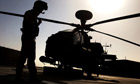
Attack helicopters’ use against Gaddafi to be formally announced amid warnings by forces minister of possible long haul for UK Ministers are to announce the deployment of Apache attack helicopters to Libya, a move seen as a significant escalation of Britain’s role in the conflict despite government denials, according to well-placed Whitehall sources. The decision will be officially announced on Thursday after a meeting of the cabinet and the National Security Council chaired by David Cameron, the Guardian understands. HMS Ocean, with four Apaches on board, is expected off the Libyan coast within days. The heavily armed helicopters will be used to protect a 16-mile buffer zone around Misrata, defence officials said. They could also be used to attack Gaddafi forces’ positions in the port city, despite possible vulnerability to rocket-propelled grenades and even rifle fire. The decision – agreed jointly with the French who are deploying 12 Tiger helicopters – had already been taken as far as military commanders were concerned. Nick Harvey, the armed forces minister, told the Commons on Tuesday that “no decision” had yet been taken. He added that the deployment would represent “a shift in tactics not an escalation of what we are doing”. But ministers and officials have made clear they are frustrated about the failure to make headway against Muammar Gaddafi’s forces and fear that military operations will not end any time soon. Libyan rebels have been pressing Nato to help them defeat Gaddafi troops, now in civilian clothes, who are continuing to fire at them in Misrata. Harvey told the Guardian the government has ruled out going to the UN to try to give the military campaign greater scope because there would not be the “groundswell of support we achieved last time” for a change of mission criteria. He warned, though, that the UK might have to brace itself for the long haul. The minister said there was probably an “over expectation” that military pressure alone would force Gaddafi out of power, and that the effort had to be pursued on three fronts. “Things are progressing in the right direction, albeit slowly. It could be that the military, economic and political pressure if sustained will get us to the point that the threat to the civilian population can be overcome,” he said. “It takes as long as it takes. I think that the whole effort is going to take quite a bit longer. Even if Gaddafi goes there is going to be a need for a smooth transition programme, and very likely a big job for the United Nations to help in the recovery phase.” A senior Whitehall source said the Libyan leader was constantly on the move. “We know where his compound is. It does not follow that that is where he is.” Libya was on the agenda of talks between Barack Obama and Cameron in Downing Street but British officials have said that they do not expect the US to reverse its earlier decision to withdraw combat aircraft. After London expressed concerns to the US, Washington agreed to send Predator unmanned drones. The US accounts for a quarter of all sorties over Libya, mainly by reconnaissance aircraft. For the second successive night, Nato air strikes targeted the area around Gaddafi’s Bab al-Aziziya compound in the Libyan capital, Tripoli. The Ministry of Defence said RAF planes attacked four heavy armoured vehicles deployed near the city of Zliten and destroyed a regime radar station at Brega. The MoD denied reports that No 10 had asked the RAF to dispatch more Tornado jets to the country. It emerged that two Typhoon pilots due to fly missions over Libya were sent back to the UK for “inappropriate behaviour”. The men, deployed at Gioia del Colle air base in Italy – where 12 Tornados and 6 Typhoons are based – returned to RAF Coningsby, in Lincolnshire, at the end of March. The disciplinary action followed a night’s drinking, but the MoD was unable to confirm whether the pilots were declared unfit to fly. The RAF said two personnel had been “returned from detachment”. They will be dealt with through internal “administrative action” which will have serious implications for their future career, defence officials said. The army’s Apaches have clocked up 100,000 flying hours across the world, a third of which have been flown on operations in Afghanistan, the MoD announced. The defence secretary, Liam Fox, said: “The army’s attack helicopter force has proven itself to be a versatile and capable attack platform providing vital support to our ground troops over the last five years in Afghanistan.” Apache force commander, Colonel Neale Moss, said: “Apache is a highly capable and versatile aircraft that has proved its value time and time again on operations in Afghanistan, and its future role is constantly evolving.” Military Libya Middle East Africa Arab and Middle East unrest Defence policy Muammar Gaddafi Obama administration United States US foreign policy Richard Norton-Taylor Nick Hopkins guardian.co.uk

 Posted by
on May 25, 2011. Filed under News, Politics, World News.
You can follow any responses to this entry through the RSS 2.0.
You can skip to the end and leave a response. Pinging is currently not allowed.
Posted by
on May 25, 2011. Filed under News, Politics, World News.
You can follow any responses to this entry through the RSS 2.0.
You can skip to the end and leave a response. Pinging is currently not allowed.