Five Libyan diplomats expelled from UK – Hague
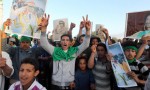
• US and Britain may arm Libya rebels • Defiant Gaddafi denounces rebels as al-Qaida terrorists • Top US officials to brief Congress on Libya strategy • Assad to give first speech since protests began 12.43pm: Hague has finished speaking. He said a UK diplomat had met Libyan rebel leaders in Benghazi on Monday and Tuesday. A foreign office spokeswoman has confirmed the diplomat was Christopher Prentice, the British ambassador in Rome. 12.39pm: Coalition air craft attacked vessels preventing aid reaching Misrata yesterday. Four were sunk and another beached. The UK has also expelled5 Libyan diplomats from London. A British diplomatic mission visited Benghazi on Monday and Tuesday, Hague said. It was headed by Christopher Prentice, the British ambassador in Rome. They have now left Libya, but further representations will follow. 12.37pm: Hague says he received a letter from the local council in Misrata yesterday, thanking him for Britain’s role in air strikes in the city. He says the letter paid tribute to the accuracy of the strikes, and said not a single person had been killed in the attacks. 12.35pm: On Sunday Nato allies decided to take on full responsibility for the UN resolution, Hague says. The transition to full Nato command is now underway. He says there are currently 16 nations conrtibuting assets to the operation. The Nato secretary general has issued a request for further contributions and Hague hopes this will be answered. 12.33pm: William Hague is about to make a statement on yesterday’s conference. 12.16pm: William Hague was on Newsnight last night. Here’s what he told Jeremy Paxman about arming the rebels. It looks like the Foreign Office is very wary of crossing this particular Rubicon, the French probably less so. And there have been reports that Egypt has been sending arms supplies them. JP: So why don’t we arm them? WH: Well because that again is governed by the United Nations resolutions and our reading of those resolutions is that the arms’ embargo applies to the whole of Libya but it might allow equipment to be given to people purely to defend themselves in certain circumstances in a limited way . But we haven’t taken the decision to do that. The way we prefer to protect the civilian areas is to take out the, make the operations that we have done, the air strikes and the missile strikes, against forces threatening to attack those civilian areas. JP: What sort of weapon supplies would be legitimate then as you understand it? WH: Well only very limited ones. We have, and since we’re not proposing to do it … JP: Limited in calibre or limited in scale? WH: No, in calibre, but the, since we’re not proposing to do that we’re not getting in to the detail of that. Others may choose to do so, but we are not proposing to arm the rebels in any form . We’re not planning to do that at the moment and, and you can easily see that there are many, that raises many policy questions as well as legal questions. So our focus is on trying to protect those civilian areas with the measures that we’ve been carrying out the last ten days. 12.11pm: The Foreign Office has been going through UN resolution 1973 with a fine-tooth comb to see whether arming the rebels is permissible. Our colleague, Julian Borger, has emailed to say that Foreign Office diplomats are saying this morning that the key paragraph in UN resolution 1973 that allows the arming of the rebels in some circumstances is this one: “4. Authorises Member States that have notified the Secretary-General, acting nationally or through regional organisations or arrangements, and acting in cooperation with the Secretary-General, to take all necessary measures, notwithstanding paragraph 9 of resolution 1970 (2011), to protect civilians and civilian populated areas under threat of attack in the Libyan Arab Jamahiriya, including Benghazi, while excluding a foreign occupation force of any form on any part of Libyan territory, and requests the Member States concerned to inform the Secretary-General immediately of the measures they take pursuant to the authorization conferred by this paragraph which shall be immediately reported to the Security Council;” Julian continues: The critical word here is ‘notwithstanding’. The FO says that means it overrides resolution 1970 (which lays down the arms embargo). So if the only way to protect a civilian area was to arm the population of that area, then it would be legally permissible. We have seen how the principle of protecting civilians through air strikes has been stretched to targeting government forces wherever they can be found. If implemented, would the principle of arming civilians and their defenders prove equally flexible? Probably. 11.57am: William Hague is due to update MPs on the progress made at yesterday’s conference in a statement to parliament at 12.30pm. We will cover it live. It would be surprising if the question of arming the rebels did not come up. Russia has come out against such a move citing. The Russian foreign minister, Sergei Lavrov, is quoted as saying: “Not long ago the French foreign minister announced that France is ready to discuss weapons supplies to the Libyan opposition with its coalition partners. Right away, Nato secretary-general (Anders) Fogh Rasmussen said the Libyan operation is being conducted to protect the population, not to arm it. We fully agree with the Nato secretary-general on this,” Lavrov said. Our colleague Robert Booth has written a piece quoting international law experts as saying that arming the opposition would breach UN security council resolution 1973 . “The embargo appears to cover everybody in the conflict which means you can’t supply arms to rebels,” said Philippe Sands QC, professor of international law at University College London. His view was backed by other experts in international law who said they could not see how the US could legally justify sending arms into Libya under the current resolutions. 11.55am: Both AP and Reuters are reporting on the rebel retreat from Ras Lanuf, 230 miles east of Tripoli. Nato planes flew over the zone where the heaviest fighting was under way and an AP reporter at the scene heard explosions, indicating a new wave of air strikes against Gaddafi’s forces. A rebel near the frontlines told AP that the opposition fighters withdrew from Ras Lanuf rather than fighting the regime forces who were closing in on them. Reuters contrasts the level of discipline between Gaddafi’s troops and the rebels. Gaddafi’s army first ambushed the insurgent pick-up convoy outside the “brother leader’s” home town of Sirte, then outflanked them through the desert, a manoeuvre requiring the sort of discipline entirely lacking in a rag-tag rebel force. On the offensive, government tanks and artillery have unleashed a fierce bombardment on towns and cities which has usually forced rebels to swiftly flee. That tactic appears to have worked once again in Ras Lanuf. “Gaddafi hit us with huge rockets. He has entered Ras Lanuf,” rebel fighter Faraj Muftah told Reuters after pulling out of Ras Lanuf. “We were at the western gate in Ras Lanuf and we were bombarded,” said a second fighter, Hisham. Scores of rebel 4×4 pick-ups raced east, away from Ras Lanuf, a Reuters journalist saw. 11.41am: A fair bit has been written about the tribal element in the Libyan conflict, with some pointing to Gaddafi’s support among some powerful tribes to explain his survival. Alaa al-Ameri – a British-Libyan economist writing for Comment is Free under a pen-name – writes, however, that portraying Libya as ‘tribal’ is wrong, and damaging to the rebel cause . Ameri says it is Gaddafi’s regime that introduced the use of the term “tribalism”, and did so to “crush the confidence of those in their own [western Libya] cities” as well as to “confuse outsiders into believing that the Gaddafi regime is all that’s holding together a fractured and disunited people”. What is the reality and importance of tribes in modern Libya? For much of Libyan history, tribal groupings were indeed a prevalent social phenomenon. However, when we refer to tribes in today’s Libya we are simply talking about a historical structuring of regional communities in a massive country. These are not the same as distinct sub-national groupings that supersede people’s national identity as Libyans – an identity defended at great cost against fascist Italy and postwar attempts by the British to divide the country… If tribalism were at the heart of this effort, why risk it all to liberate towns in the west? Why have towns such as Misrata, Zawiya and Zintan, all a short drive from Tripoli, chosen to join the National Transitional Council – a fledgling government on the other side of the country that has so far been powerless to support them or come to their aid? 11.30am: Ian Black, who is Tripoli, says that even if the rebels were to be armed by coalition forces, “it would be a very long haul to lick them into shape – this disorganised and rather chaotic group of people into a fighting force and a coherent movement strong enough to overthrow the regime”. I don’t see any sudden, dramatic end to this story. I think it’s far more likely to become a stalemate between the east and the west, as the international community continues, I have to say, to dither in a pretty incoherent way about what it wants to achieve. People talk about wanting Gaddafi to go, but so far they haven’t provided anything like the means that will be required to let that happen. 11.26am: There’s a couple of interesting articles on this “flicker” of al-Qaida that Chris McGreal began to address until he was cut off. This piece in the Washington Post says US officials are not unduly concerned . US officials played down their concern about al-Qaeda’s presence, saying that its numbers appear negligible and that the terrorist network has had no discernible influence on the groups seeking to oust Libyan dictator Muammar Gaddafi. Kim Sengupta in the Independent says the protest movement is a complex and composite body, with the intelligentsia in Benghazi talking passionately about the craving for democracy, civil rights and pluralism, while there has been a visible increase in the number of those espousing fundamentalist doctrine. Here’s what Sengupta has to say about one of the rebel leaders . Abdul Hakim al-Hasidi, who took over as “chief of security” at Darnah at the start of the uprising on 17 February, spent five years in Afghanistan where he supposedly met Bin Laden and frequented, according to US intelligence briefings at the time, a training camp used by both the Taliban and al-Qaida. Hasidi claims he has 1,200 fighters, which would make his group one of the largest contingents among the revolutionaries, known as the Shabaab. He has personally led units into battles in Bin Jawad and Ras Lanuf where the action has been fierce. It is, however, not easy to ascertain details of Hasidi’s links with Islamic militancy. During a recent meeting in Darnah, he was reticent to talk about his Afghan sojourn and his alleged meetings with Bin Laden. He was not a member of al-Qa’ida, he stated, and did not follow its ethos. Hasidi refused to elaborate on a previous observation that Bin Laden “had his good points” and described claims of his links with the head of al-Qaida as “just tales”. The counter-extremism thinktank last week addressed this issue, and its director of research, James Brandon, made this sensible point : Although Gaddafi’s claims that the opposition is an al-Qaida front are utter nonsense, it is clear that the fighting in Libya has created a vacuum in which extreme groups – including al-Qaida – may be able to operate. There are signs that al-Qaida leadership, both in Pakistan and in North Africa, believe that events in Libya could be a chance for them to create a second Iraq. The international community needs to work with the opposition leadership in Libya in order to shut out these extremists before they can hijack Libya’s popular uprising for their own ends. 11.11am – Syria: Assad’s speech keeps slipping, now apparently 1.30 UK time. Presumably he’s working out how much ground to cede to keep the protesters happy, without alienating his security people. The man is on a tightrope. 11.04am: Hillary Clinton yesterday said she believed arming Libyan rebels would be OK under UN security council resolution 1973. William Hague, the British foreign secretary, agreed that the resolution made it legal “to give people aid in order to defend themselves in particular circumstances.” However, in an exchange in the Commons on Libya on 18 March , David Cameron gave a very different answer to Bob Stewart, a Tory MP, who served in Bosnia. Here’s the exchange. Bob Stewart (Beckenham) (Con): Speaking as someone who has watched well-armed Bosnian Serb units smash through civilian populations, may I ask my right hon friend the prime minister whether security council resolution 1973 allows us, under its provision on “all necessary measures”, to avoid the arms embargo and directly arm the people who are fighting against Gaddafi in Benghazi and elsewhere? The prime minister: The first point I would make to my hon friend is how welcome it was that Bosnia was sitting on the security council and able to vote in favour of this resolution-for good historical reasons. The resolution helps to enforce the arms embargo, and our legal understanding is that that arms embargo applies to the whole of Libya . Paragraph 4 authorises member states “to take all necessary measures…to protect civilians and civilian populated areas under threat of attack” in Libya, including Benghazi. That is very strong language, which allows states to take a number of military steps to protect people and harm those who are intending to damage civilians. It could not be clearer, and the legal advice is clear. It will be interesting to see how the US and Britain finesse this issue legally. Some argue that a new UN resolution is needed if the west wants to arm the rebels. That, however, is likely to be blocked by Russia and China, already unhappy with western air support for the rebels. 10.46am – Syria: The delay in Assad’s speech has prompted some sarcastic tweets, such as this one . Of course lots of political speeches are delayed, just ask anybody who has ever covered a US presidential campaign. 10.41am – Syria: President Assad of Syria was supposed to be speaking about now, a contact in Damascus tells us, but his speech has been delayed until midday UK time . 9.34am – Syria: A lot of attention will be on Syria today where President Bashar al-Assad is due to give his first public speech since the outbreak over a week ago of pro-democracy protests that have killed more than 60 people. Martin Chulov in today’s Guardian says Assad is likely to lift emergency laws, which outlaw public gatherings, and introduce a corruption crackdown. The state news agency said Assad, who succeeded his father 11 years ago, would address “the internal issues and the latest occurrences”, Reuters reports. Assad yesterday sacked the government in a largely cosmetic measure as real power lies with him, his family and the security apparatus. “Assad is being subjected to internal and external pressures. He has prepared a plan to give the impression to public opinion that he has begun reforms,” Maamoun al-Homsi, who was jailed for five years for demanding broader political freedoms, told Reuters from exile in Canada. In a sign of jumpiness, the Syrian government has expelled three Reuters journalists in recent days – its senior foreign correspondent in Damascus and a two-man television crew who were detained for two days before being deported. In an analysis piece, the Guardian’s foreign affairs expert, Simon Tisdall, writes that Assad’s failure to bring about change was ultimately his own , raising doubts about his political courage and judgment. 9.15am: In this audio, Chris McGreal reporting from Ajdabiya, reports on the sense of anger and betrayal among the rebels after they were driven back by Gaddafi’s troops. Just a few days ago the rebels were announcing they were marching to Tripoli and they’d be there by the end of the week. Yesterday as they were retreating they were angrily demanding to know where Sarkozy was …they feel betrayed when the air strikes are not there to protect them. Chris also detects a sense of weariness among the rebels of having to go up and down the same hundred miles of road as they had hoped to capture Sirte, Gaddafi’s home town which would have been a huge psychological blow to the regime. He also pours cold water on the notion that al-Qaida has any sort of traction within the movement before he is cut off. 8.20am: A senior Obama administration official said the US would soon send an envoy to Libya to meet rebel leaders. The US will want to have a clearer idea exactly who the rebels are before going down the path of arming them, especially as Nato’s top commander, US Navy admiral James Stavridis, said officials had seen “flickers” of possible al-Qaida and Hezbollah involvement with the rebel forces. The US will not want a repeat of the “blowback” experience of Afghanistan, when some of the Mujahideen it backed against the Soviets turned virulently anti-western. 8.00am: Reports overnight indicated that the rebels were in flight from coastal cities of Brega and Ras Lanouf, which they had regained just days before. The opposition were in full retreat after being hammered by tanks and rockets. Only a day earlier, they where roaring westward in hopes of taking Sirte, Gaddafi’s home town. They reached within 60 miles of the city before being repulsed. Muammar Gaddafi, meanwhile, shows no sign of buckling. As foreign ministers met in London yesterday to discuss the future of Libya, Gaddafi said that there was no room for compromise with the Benghazi-based rebels, who he again described as al-Qaida terrorists. He warned that the UN-imposed no-fly zone would turn north Africa into a “second Afghanistan”. US policy is expected to come under close scrutiny later today when US defence secretary Robert Gates – a reluctant warrior – and the more gung-ho US secretary of state, Hillary Clinton, brief members of the House and Senate in closed-door, back-to-back sessions. Their Capitol Hill appearance comes as a new Associated Press-GfK poll found the country split on US involvement in military actions in Libya, with 48% approving and 50% disapproving. One of the questions Clinton is likely to face is whether the coalition should arm the rebels. In London, Clinton said for the first time that she believed arming rebel groups was legal under UN security council resolution 1973. Libya Middle East Syria Arab and Middle East unrest Mark Tran Adam Gabbatt guardian.co.uk

 Posted by
on March 30, 2011. Filed under News, Politics, World News.
You can follow any responses to this entry through the RSS 2.0.
You can skip to the end and leave a response. Pinging is currently not allowed.
Posted by
on March 30, 2011. Filed under News, Politics, World News.
You can follow any responses to this entry through the RSS 2.0.
You can skip to the end and leave a response. Pinging is currently not allowed.