Bin Laden ‘was captured then killed’
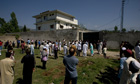
• Bin Laden’s daughter says he was captured then killed • Claims that waterboarding helped search for Bin Laden • 500 Euros found sewn into al-Qaida leader’s clothing 5.10pm BST / 12.10pm ET: A lot of Americans needed reminding exactly who Osama bin Laden was , after his death was announced, according to evidence from Twitter posts and Yahoo searches: At first glance, this looks insane, but there are a few plausible explanations. If you are between the ages of 13 and 17 today, then you were either a toddler or a very young child on 9/11. For the oldest kids in the group, the 2008 presidential election was likely the first major event of their political lives, and bin Laden wasn’t a huge concern for either candidate. Nerdier kids might have been interested in the 2006 election, but even then, Iraq was the main topic of conversation. 4.55pm BST / 11.55am ET: The award-winning investigative news site ProPublica has a good compilation of coverage of the raid that killed Osama bin Laden and the events surrounding it (although it is parochially narrowly in its focus on US sources). But if you’ve been in a cave in, say, Tora Bora, for the past few days ProPublica’s page is an excellent place to start. And here , of course. 4.40pm BST / 11.40am ET: CNN’s national security team tweets: That would be Janet Napolitano, the head of the US department of homeland security. 4.29pm BST / 11.29am ET: On the Guardian’s Comment is Free America site, media commentator Dan Kennedy examines the New York Times’s “tortured line on torture” in the wake of the claims that its use helped produce information leading to the tracking down of Osama bin Laden: The New York Times, as the US’s leading news organisation, has harmed the public discourse by refusing to call torture by its proper name. This latest instance is just another example of how it has tied itself into knots in its ongoing attempt to avoid saying the obvious. 4.09pm: I’m going to hand over the blog to my colleague Richard Adams in the Guardian’s Washington bureau now. Here’s a summary of today’s developments: • Bin Laden’s 12-year-old daughter has told that Pakistani officials US forces captured her father alive before shooting him dead , according to al-Arabiya. • The White House has denied claims by an ex-CIA counterterrorism chief that Bin Laden’s killing was a result of information obtained by enhanced interrogation techniques , including waterboarding. • Bin Laden’s relatives are being treated at a military hospital in Rawalpindi , according to the BBC. • People who lived with Bin Laden at the Abbottebad compound and who remained at the property after the raid are being interrogated by Pakistani intelligence , CNN reported. 3.56pm: A couple of interesting developments from Pakistan: The BBC’s Pakistan correspondent, Aleem Maqbool, tweets that Bin Laden’s relatives are being treated in a military hospital in Rawalpindi. CNN says some people left at the compound after the killing of Bin Laden are in Pakistani custody and are being interrogated , according to a senior Pakistani intelligence source. 3.52pm: Cord Jefferson, on good.is , blogs on the fact that the fifth most popular Bin Laden search is “Who is Osama bin Laden?” citing Yahoo data that says searches related to the al-Qaida leader have jumped nearly 10,000% since Sunday’s killing. Rather than just mock those who don’t know who Bin Laden is, Jefferson makes some salient points: Though he was one of the most important criminals in the world for the last decade, a significant number of people searching Yahoo have no idea who Osama bin Laden was. Thankfully, most of these people are children—two-thirds are aged 13 to 17—but, considering how the entire nation mourns every September 11, it seems a bit outrageous that even young kids don’t know Osama. This raises the question: Is it possible that children are learning about 9/11 but not about the people and organisations behind 9/11? And if so, is it any wonder that many Americans now make blanket condemnations of Islam instead of placing the blame for terrorism where it lies—with fringe rogues like bin Laden? 3.39pm: You may have read about how the US Navy Seals who carried out the attack on the Abbottabad compound destroyed one of their helicopters that was grounded during the raid. Well, the reason they blew it up appears to be that it was very sophisticated technology that they did not want falling into the wrong hands. On the defence technology blog on Aviation Week, Bill Sweetman writes : Well, now we know why all of us had trouble ID’ing the helicopter that crashed, or was brought down, in the Osama raid. It was a secretly developed stealth helicopter, probably a highly modified version of an H-60 Blackhawk. Photos published in the Daily Mail and on the Secret Projects board show that the helicopter’s tail features stealth-configured shapes on the boom and tip fairings, swept stabilizers and a “dishpan” cover over a non-standard five-or-six-blade tail rotor. It has a silver-loaded infra-red suppression finish similar to that seen on some V-22s. No wonder the team tried to destroy it. _ 3.34pm: In a response to the foreign affairs committee report on Afghanistan and Pakistan, the UK foreign secretary, William Hague, has reiterated Britain’s commitment to Afghanistan. He said: The death of Osama Bin Laden, although a positive development in terms of our counter-terrorism effort, does not change our strategy in Afghanistan. We remain committed to our military, diplomatic and development work to build a stable and secure Afghanistan. We will work, with our Afghan and international partners to ensure that Afghanistan can never again be a safe haven for international terrorist groups like al-Qaida. This is a decisive moment. The Taliban should recognise that now is the time to separate themselves from al-Qaida and participate in a peaceful political process. 3.29pm: A New York Times/CBS News poll has shown a boost for Obama’s approval ratings following the killing of Bin Laden. In all, 57% said they now approved of the president’s job performance, up from 46% last month. But more than six in 10 Americans said that killing Bin Laden was likely to increase the threat of terrorism against the United States in the short term and only 16% said they felt safer as a result. With speculation mounting that the US might now leave Afghanistan the poll found that nearly half said the nation should decrease troop levels in Afghanistan. But more than six in 10 also said the United States had not completed its mission in Afghanistan. A USA Today/Gallup poll found 71% gave moderate of great credit to Obama for the operation (compared to 98% credit crediting the US military and 52% Bush). A third of people said they feel a lot more confident on Obama as commander in chief, while 21% feel a little more confident. But more than 6 in 10 say acts of terrorism against the US are likely in the next several weeks, “a significant bump and the highest rate of public nervousness in eight years” reports US Today. 2.59pm: Channel 4′s Lindsey Hilsum tweets that enterprising children in Abbottabad are making the most of the focus on their city: Yesterday at #binladen hse kids were collecting chopper wreckage. Today they’re selling the the bits! @channel4news 2.36pm: A former head of counterterrorism at the CIA has told Time that techniques such as waterboarding did produce the information that eventually led to Bin Laden’s death . The assertion by Jose Rodriguez, who ran the CIA’s counterterrorism Centre from 2002 to 2005 has been rejected by the White House. It also contradicts the conclusions of an investigation by the New York Times ( see 10.38am ). Massimo Calabresi writes: Information provided by KSM and Abu Faraj al Libbi about Bin Laden’s courier was the lead information that eventually led to the location of [bin Laden's] compound and the operation that led to his death,” Rodriguez tells Time in his first public interview. Rodriguez was cleared of charges in the video destruction investigation [relating to videos showing senior al-Qaida officials being interrogated] last year. Rodriguez agrees that other events played a role in developing the intelligence on bin Laden’s whereabouts. And he says that despite widespread focus on KSM, al Libbi’s information was the most important. “Both KSM and al Libbi were held at CIA black sites and subjected to enhanced interrogation techniques,” Rodriguez says. “Abu Faraj was not waterboarded, but his information on the courier was key.” Calebresi writes that reports suggest information on Bin Laden’s courier provided by KSM came weeks or months after he was subjected to enhanced interrogation techniques but Rodriguez says al Libbi’s tips came “just one week after he was subjected to the harsh treatment”. Calebresi writes: One former senior intelligence official says that “once KSM decided resistance was unwise, he then started spilling his guts to the agency and started providing lots of info, like the noms de guerres of couriers and explaining how al-Qaeda worked.” Rodriguez says, “It’s a mistake to say this was about inflicting pain. These measures were about instilling a sense of hopelessness and that led them to compliance.” None of the Bush officials made a clear distinction between inducing compliance and torture. Rodriguez says the US should go back to using enhanced interrogation techniques. 2.19pm: In an interview in the Evening Standard Ken Livingstone has accused Obama of behaving like a “mobster” because Bin Laden was assassinated and not captured alive, my colleague Andrew Sparrow writes on his politics blog . Livingstone also said the scenes of jubilation in the US following Bin Laden’s death would increase the risk of a terrorist attack on London. I just looked at [the pictures of Americans celebrating Bin Laden's death] and realised that it would increase the likelihood of a terror attack on London. That’s very much the American style but I don’t think I’ve ever felt pleased at the death of anybody. The real problem for London is that after America we’re a big target so it’s a very dangerous time at the moment. We should have captured [Bin Laden] and put him on trial. It’s a simple point – are we gangsters or a Western democracy based on the rule of law? This undermines any commitment to democracy and trial by jury and makes Obama look like some sort of mobster. 2.13pm: Karl Vick, on Time.com, assesses the political fallout on Israel. He quotes a couple of commentators as saying that the news is not necessarily good for the Israeli prime minister, Biniyamin Netanyahu, who could face renewed US pressure to cut a deal with the Palestinians: In Yedioth Ahronoth, the estimable Nahum Barnea had the same thought: “Netanyahu was quick to congratulate Obama on the successful operation. He did well to do so. We don’t know what his private thoughts on the matter were. I suspect that he was divided: on the one hand, like most Israelis, he celebrated the victory of good over evil, the sons of light over the sons of darkness. On the other, he realized that the Obama’s political gain is going to make it more difficult for him in his dealings with the US administration.” 1.24pm: In the absence of pictures of the operation that led to the killing of Bin Laden, the photograph of Barack Obama and Hillary Clinton supposedly watching events unfold has become one of the iconic images of the episode. But the CIA director Leon Panetta has made clear that they did not see the shooting of Bin Laden or much else. He told PBS Newshour : Once those teams went into the compound, I can tell you that there was a time period of almost 20 or 25 minutes where we – you know, we really didn’t know just exactly what was going on. And there were some very tense moments as we were waiting for information. But finally, Adm. McRaven came back and said that he had picked up the word “Geronimo,” which was the code word that represented that they got bin Laden. _ 12.54pm: A doctor who sold the piece of land where Bin Laden’s final hideout was built identified the buyer as Mohammad Arshad, a name that matched one of two Pakistani men often seen coming out of the al-Qaida chief’s compound, AP reports. Property records obtained by The Associated Press show Arshad bought adjoining plots in four stages between 2004 and 2005 in Abbottabad, the town where bin Laden hid for up to six years just a short drive from the Pakistani capital Islamabad. Dr Qazi Mahfooz Ul Haq said Wednesday he sold a plot of land to Arshad in 2005. He said the buyer was a “modest, humble type of man” who claimed to be purchasing it for his uncle. There have been suggestions that “Arshad Khan” was the name of the “courier” sought by Americans, whose trail led them to Bin Laden. 12.46pm: Intriguing details of Bin Laden’s possessions and his readiness to flee when he was killed have been revealed by Politico . Jonathan Allen writes: Osama bin Laden had cash totalling 500 Euros and two telephone numbers sewn into his clothing when he was killed — sure signs that he was prepared to flee his compound at a moment’s notice — top US intelligence officials told members of Congress at a classified briefing in the Capitol Tuesday. The evidence of cash — which amounts to about $740 in U.S. dollars — and phone numbers was divulged to support the administration’s belief that bin Laden was prepared to escape the compound if alerted to an impending attack, the source said. Interesting stuff, although it would be surprising if the world’s most wanted man didn’t have an escape plan that could be put into operation with little notice. 12.13pm: Remember Gary Faulkner? He was the sword-wielding American arrested in northern Pakistan while hunting Bin Laden. He has given an interview to ABC saying he flushed Bin Laden out and arguing that he should be entitled to part of the $25 million reward for his capture. Faulkner said: I had a major hand and play in this wonderful thing, getting him out of the mountains and down to the valleys… Someone had to get him out of there. That’s where I came in. I scared the squirrel out of his hole, he popped his head up and he got capped. He also dismissed the idea that Bin Laden had been living at the Abbottabad compound for six years: “He hadn’t been living there for no damn six years. I absolutely flushed him out.” ABC notes Faulkner “has not been mentioned in the government’s detailed account of how the CIA painstakingly tracked down Bin Laden”. 11.50am: The Guardian has video of funeral prayers for Bin Laden and anti-American protests in Pakistan _ 11.42am: Much praise has been heaped on the US navy’s Seal Team 6, which stormed Osama bin Laden’s Abbottabad compound, with a number of glowing tributes penned to the elite unit, formed in the aftermath of the botched US response to the Tehran hostage crisis. But as differing accounts of the operation emerge, my colleague Sam Jones writes that its reputation is not without blemish : In October last year sailors from the unit were dispatched to rescue the British aid worker Linda Norgrove, who had been kidnapped by militants in Afghanistan. Norgrove died during the raid after one of the Seals threw a fragmentation grenade close to where she was sheltering. Initial reports suggested she had been killed by an insurgent’s suicide bomb vest. But when the Seal commanding officer reviewed surveillance video recordings he saw an explosion after one of the Seals threw something in Norgrove’s direction. A number of the Seals were disciplined as a result. The last time the public was made aware of a Seal raid on Pakistani soil was three years ago, when the raiders flew a mile over the border to the town of Angurada. Their high-value targets had fled and those left behind in the compound fought back, resulting in a number of civilian casualties, according to US and Pakistani officials. Seal Team 6 were also part of the joint operation to rescue Jessica Lynch, the US soldier who became an icon for the Iraq war. The rescue was portrayed as a daring assault to rescue a comrade who had been mistreated in the hospital. But Iraqi doctors later contradicted this account , insisting she was treated well and there was no need to storm the hospital as no Iraqi soldiers were present. 11.03am: The implications of Bin Laden’s death for Indonesia, the world’s biggest Islamic country, are examined by International Crisis Group’s Sidney Jones, in the Jakarta Post . She identifies three possible consequences. The first is a temporary shift back to foreign targets. Jones says for the last two years Indonesian extremists have moved away from attacks on symbols of the West but “Bin Laden was such a powerful symbol and so revered in the extremist community, however, that calculations of costs and benefits may be overridden by a felt need to respond somehow to his death. The ubiquitous television images of cheering Americans may strengthen that resolve”. The second is the possibility of revenge attacks, although Jones says planning an attack takes time and Indonesian extremists “do not have a successful track record in this regard”. The third possible consequence is a strengthened attachment to al-Qaida. Jones writes: On 25 January this year, Umar Patek was arrested in Abbottabad, the same town where Bin Laden was living. It was probably not a coincidence (indeed, may have been part of the same operation). Indonesian authorities need to be asking Patek, who remains in detention in Pakistan, exactly what the nature of his communication was with the al-Qaida organization and who else from Southeast Asia is actively working with al-Qaida in propaganda, training, or even operations. In his desire to work with Bin Laden, Patek, a former Jamaah Islamiyah (JI) member who was one of the original Bali bombers, follows in the footsteps of Hambali, the JI leader detained in Guantanamo whose relationship with al-Qaida until his arrest in 2003 is outlined in a recent WikiLeaks document … The death of Bin Laden could lead to a renewed push to bolster these ties or to an intensified propaganda campaign based on al-Qaida materials, especially from AQAP [al-Qaida in the Arabian peninsula], translated into Indonesian. 10.38am: “Did brutal interrogations produce the crucial intelligence that led to the killing of Osama bin Laden?” That is the question being asked by the New York Times and others as Bush administration officials, in the aftermath of the death of the al-Qaida leader, c laim vindication for methods such as waterboarding . More specifically people are asking whether Khalid Sheikh Mohammed, the alleged mastermind of the 9/11 attacks on the US, provided crucial information while being tortured. The Times writes: A closer look at prisoner interrogations suggests that the harsh techniques played a small role at most in identifying Bin Laden’s trusted courier and exposing his hide-out. One detainee who apparently was subjected to some tough treatment provided a crucial description of the courier, according to current and former officials briefed on the interrogations. But two prisoners who underwent some of the harshest treatment — including Khalid Sheikh Mohammed, who was waterboarded 183 times — repeatedly misled their interrogators about the courier’s identity … In 2002 and 2003, interrogators first heard about a Qaeda courier who used the nom de guerre Abu Ahmed al-Kuwaiti, but his name was just one tidbit in heaps of uncorroborated claims … According to an American official familiar with his interrogation, Mr. Mohammed was first asked about Mr. Kuwaiti in the fall of 2003, months after the waterboarding. He acknowledged having known him but said the courier was “retired” and of little significance. It also quotes Tommy Vietor, spokesman for the National Security Council, as saying: The bottom line is this: If we had some kind of smoking-gun intelligence from waterboarding in 2003, we would have taken out Osama bin Laden in 2003. But the Times writes that an al-QaIda operative named Hassan Ghul, captured in Iraq, said Kuwaiti was a trusted courier who was close to Bin Laden, as well as to Mohammed. It says “the details of Mr. Ghul’s treatment are unclear, though the C.I.A. says he was not waterboarded”. 10.12am: Good morning. Welcome to our continuing live coverage of the aftermath of the killing of Osama bin Laden. Doubts are continuing to be cast on the accounts of the raid on the house in Abbottabad, Pakistan, that were initially given by US officials. After White House admissions that early official reports claiming Bin Laden had been armed and cowered behind his wife during the assault were false , al-Arabiya is now reporting that the al-Qaida leader’s 12-year-old daughter, told Pakistani officials US forces captured her father alive before shooting him dead: The [Pakistani] official said a 12-year-old daughter of bin Laden was among the six children rescued from the three-storey compound. The daughter has reportedly told her Pakistani investigators that the US forces captured her father alive but shot him dead in front of family members. According to sources, Bin Laden was staying on the ground floor of the house and was dragged on the floor to the helicopter after being shot dead by US commandos. There were conflicting reports about the second person the US forces took along with them. Some Pakistani officials say it was one of Bin Laden’s sons injured by the US commandos and thrown onto a separate military chopper; others say he was killed in the operation and it was only his dead body that they took along. While any account given by Bin Laden’s family is likely to be treated with scepticism (especially coming via Pakistani security officials), the changing account given by the White House may lend this version of events more credence than it would otherwise have been granted. Osama bin Laden al-Qaida Pakistan Global terrorism United States Obama administration Middle East US foreign policy Haroon Siddique Richard Adams guardian.co.uk

 Posted by
on May 4, 2011. Filed under News, Politics, World News.
You can follow any responses to this entry through the RSS 2.0.
You can skip to the end and leave a response. Pinging is currently not allowed.
Posted by
on May 4, 2011. Filed under News, Politics, World News.
You can follow any responses to this entry through the RSS 2.0.
You can skip to the end and leave a response. Pinging is currently not allowed.