Bernanke makes US economy speech
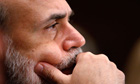
Ben Bernanke, chairman of the US Federal Reserve, holds his first ever live press conference to explain monetary policy 2.44pm: A silly question from a nameless interlocator, asking what can the Fed do about providing more jobs. Oh god, it was from the New York Times. Really. “Clearly it is the case that we have done extraordinary things” to get the economy moving, Bernanke argues. And now a question about the ineffectiveness of the second round of quantitative easing – in which the Fed attempted to push on a piece of string using a wodge of cash. Bernanke unsurprisingly thinks that the policy he piloted was effective. It wasn’t going to be a panacea, Bernanke says. 2.43pm ET: And now a question about the end of quantitative easing. Something something something. 2.38pm ET: At last a lovely British accent, via a question from Robin Harding of the FT, looking like a young Michael Caine. The question was about inflation expectations. The answer is so fascinating that words alone can’t convey it. 2.37pm ET: For how long will US economic growth and growth in the labour market continue to be moderate, asks a polite man from Bloomberg. “The pace of improvement is still quite slow, we are digging ourselves out of quite a big hole,” Bernanke says. Basically, a while yet. 2.33pm ET: What can or should the Fed do able Americans being upset about high gas and food prices, wonders the Wall Street Journal. “Gas is of course a necessity, people need to drive to get to work,” notes Bernanke. Well I walked to work this morning, but his broad point is accurate. Demand from growing economies has driven up the demand for oil, while disruptions in the Middle East has restricted supply. “This is a very adverse development,” says Bernanke. “There’s not much the Federal Reserve can do about gas prices per se.” “Our view is that gas prices will not continue to rise at the recent pace… that will provide some relief on the inflation front but we’ll have to wtach that very carefully.” 2.30pm ET: Critics say Fed policy has driven down the value of the US dollar. What does Mr Bernanke have to say to those critics? (That’s asked by someone called Steve.) Bernanke doesn’t really answer the question, and basically says that if the US economy is strong then the US dollar will be strong. Which is true. Low inflation and a strong economy, that’s the ticket. 2.28pm ET: Not a huge PR success so far, based on this tweet from uber-blogger Felix Salmon of Reuters. Still, it’s early days. I think it might have helped if Bernanke had provided a simultaneous translation from Latin. 2.25pm ET: Cracking stuff so far, assuming you have a PhD in macroeconomics from a decent university. If you don’t, it’s slightly on the dry side. 2.15pm ET: And right on time, Chairman Bernanke takes the stage and starts speaking from his prepared text. Alongside Bernanke’s press conference, the Federal Open Market Committee has issued its latest announcement regarding US interest rates: Information received since the Federal Open Market Committee met in March indicates that the economic recovery is proceeding at a moderate pace and overall conditions in the labor market are improving gradually. Household spending and business investment in equipment and software continue to expand. However, investment in nonresidential structures is still weak, and the housing sector continues to be depressed. Commodity prices have risen significantly since last summer, and concerns about global supplies of crude oil have contributed to a further increase in oil prices since the Committee met in March. Inflation has picked up in recent months, but longer-term inflation expectations have remained stable and measures of underlying inflation are still subdued. The upshot to all this is that the FOMC is leaving interest rates unchanged: The Committee will maintain the target range for the federal funds rate at 0 to 0.25 per cent and continues to anticipate that economic conditions, including low rates of resource utilization, subdued inflation trends, and stable inflation expectations, are likely to warrant exceptionally low levels for the federal funds rate for an extended period. 2.10pm ET: Here’s how the Fed explains today’s event: Chairman Ben S Bernanke will hold press briefings four times per year to present the Federal Open Market Committee’s current economic projections and to provide additional context for the FOMC’s policy decisions. The introduction of regular press briefings is intended to further enhance the clarity and timeliness of the Federal Reserve’s monetary policy communication. The Federal Reserve will continue to review its communications practices in the interest of ensuring accountability and increasing public understanding. 2pm ET: Welcome to live coverage of an unusual event: for the first time the chairman of the US Federal reserve, Ben Bernanke, holds a press conference to explain the Fed’s interest rate setting decisions and to explain to outlook for the US economy and its monetary policy. The press conference kicks off at 2.15pm ET, and you can follow it on streaming video through this link – and the Guardian’s analysis right here. For background, here’s how the Financial Times’s Lex column [subscription required] reads today’s historic press conference: Longer term, however, conferences should strengthen the chairman’s control over the Fed’s message. Of late, Fedspeak has come largely from hawkish regional governors. This obscures Mr Bernanke’s feat at the last meeting in mustering unanimous support for a highly controversial policy. He is still guiding the Fed. Now he will have ample opportunity to demonstrate this, and lay out his case. Ben Bernanke US Interest rates US economy United States Economics Richard Adams guardian.co.uk

 Posted by
on April 27, 2011. Filed under News, Politics, World News.
You can follow any responses to this entry through the RSS 2.0.
You can skip to the end and leave a response. Pinging is currently not allowed.
Posted by
on April 27, 2011. Filed under News, Politics, World News.
You can follow any responses to this entry through the RSS 2.0.
You can skip to the end and leave a response. Pinging is currently not allowed.