Anguish strengthens Misrata resolve
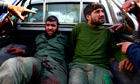
More than 1,000 people have died in Misrata since protests began in February, but its volunteer fighters remain defiant The slight, smooth-cheeked young man sat patiently in the hospital reception as gurneys rushed by carrying the dead and wounded from the frontline. He had two crutches at his side. He had one leg. His name was Hassan Ibrahim, he said. Born in 1992 in Misrata, Libya’s third biggest city, home to more than 300,000 people. A first-year engineering student. What had happened? He flipped open a laptop, and called up a picture taken on 18 March, a month after the uprising began, and the day when Muammar Gaddafi sent in five brigades to crush it once and for all. Ibrahim had been walking along a street near the city centre with several friends when a column of tanks suddenly advanced, firing. A shell exploded close to them. The photograph showed his torso, his right leg, and mangled flesh where his left thigh used to be. Bleeding heavily, he was brought to the private clinic that now serves as a trauma hospital. Doctors who just a few weeks earlier had barely even seen a bullet wound had to make a quick decision. They amputated his left leg just below the hip to save his life. Ibrahim grimaced slightly as he stood up, and then said: “What happened to me is nothing compared to others who have given their lives.” This is the spirit of Misrata, a besieged city that has resisted everything that Gaddafi has thrown at it for more than two months, thanks to the solidarity and fierce determination of its people. On Friday night the Libyan government admitted that its military solution in Misrata was not working, with deputy foreign minister Khaled Kaim saying local pro-Gaddafi tribes might be sent into the city to end the rebellion. The rebels even claimed that the tables had been turned on Gaddafi’s forces. “Misrata is free, the rebels have won. Of Gaddafi’s forces, some are killed and others are running away,” rebel spokesman Gemal Salem said. But heavy fighting continued on Saturday, with street battles in the area around the technical college, close to where Gaddafi’s forces have a base. By noon at least 14 rebel fighters had been killed. But each day of anguish only appears to strengthen the people’s resolve. Many thousands of men who had never held a gun before have taken up arms and fight street by street against an enemy with far superior firepower. Other volunteers drive bulldozers or trucks, bringing sand from the beach to stop Gaddafi’s tanks rolling down the streets. Families forced to flee from the outskirts of the city, or the city centre, where the fighting has been heaviest, have been welcomed into strangers’ homes in safer areas. “People who never knew each other are now living together in the same home,” said Ibrahim Amer, 21. “In a big house, you can find 50 or 60 people living together.” Committees have been set up to help the poor and the displaced, who collect free food from warehouses and $10 in cash daily. Women prepare meals, which are sent out to the hundreds of checkpoints manned by young volunteers. The cost of the resistance has been huge. At least 1,000 people have died, picked off by Gaddafi’s snipers, who set up base in the city’s tallest buildings, or by indiscriminate shelling. Thousands more have been injured. “We have done too many amputations here, arms, legs, both legs,” said Dr Khalid Abu Falgha, a member of Misrata’s medical committee. “When this is over we are going to need so many prosthetic limbs.” No one knows when that will be. But this much is certain: nobody in Misrata can contemplate life under Gaddafi again. They will win, or they will die. “If people put their guns down, Gaddafi is going to kill us all,” said Haythem Ibrahim, who runs a large company importing goods from China. He has a US passport, but has never contemplated leaving the city by boat, as he could have. Instead, he spends most days at the hospital with his brother Suleiman, archiving footage of the revolution – and the war. The brothers’ younger twin siblings, 24, a dentist and trainee doctor, are also at the hospital, working 18-hour days, sleeping on the premises. “The people of Misrata are all in this together – this revolution has brought us together,” said Haythem, 31. “I have lost so much of my business because of this. But it’s only money. People are sacrificing much more.” The uprising began on 19 February, a small demonstration called in support of the people of Benghazi in the east, whose own protests had been crushed by the government. For 14 days the people of Misrata controlled the city. Some say it was the greatest time of their lives. People flooded the streets, crying with joy. But they knew Gaddafi’s forces would come back. And they were prepared. When a large convoy of Gaddafi tanks and armoured vehicles reached the city on 6 March, they met no resistance and were drawn into the city centre. Hundreds of young men were waiting on the roofs of buildings, armed with petrol bombs and “gelatinas”, tiny bombs made with TNT, which they had been instructed to prepare. The mobile network was still working then, and once the order was given the homemade bombs rained down on the convoy. Gaddafi’s forces were humbled. Many died, others retreated. Inside some of the destroyed tanks rebels found cakes and juice; the troops had been so convinced that they would retake the city they had prepared for a party. On 18 March, a day after Nato instituted the no-fly zone, Gaddafi’s forces launched a furious attack on Misrata. For two days they pounded it, but again the rebels rode out the attack. Gaddafi’s troops were unable to take control of the city, and remain on its southern side. Last week many of the snipers in the tallest buildings were killed, captured or chased away by the rebels. But the shelling by Gaddafi’s forces continued. On Wednesday night, Ibrahim was in the hospital again. He had an inch-long wound on his neck. “I was sleeping at home with my family when I heard shells falling nearby,” he said. “I went to wake up my brother and tell him to move. Then the shell came through the roof.” A piece of shrapnel nicked his neck. When he looked at the wall behind him, he saw a big piece of metal. If it had landed a few inches closer, he would have been dead. He shrugged, and half-smiled. Then he excused himself, took hold of his crutches and hopped away towards his car, which he has already learned to drive with one leg. On the back of his jersey was sewn a small flag, black, red, and green, with a star and crescent in the middle – the Libyan flag before Gaddafi took over. ■ The British government will face pressure to explain its strategy in Libya this week amid growing concerns that a “stalemate” has been reached. Writing for the Observer , shadow foreign secretary Douglas Alexander has said the government needs a “clearer and better articulated strategy” and that “strategic, tactical and operational matters” had become “worryingly confused”. Libya Middle East Muammar Gaddafi Arab and Middle East unrest Xan Rice guardian.co.uk

 Posted by
on April 23, 2011. Filed under News, Politics, World News.
You can follow any responses to this entry through the RSS 2.0.
You can skip to the end and leave a response. Pinging is currently not allowed.
Posted by
on April 23, 2011. Filed under News, Politics, World News.
You can follow any responses to this entry through the RSS 2.0.
You can skip to the end and leave a response. Pinging is currently not allowed.