Tomlinson inquest enters day 15
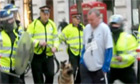
Full coverage from the inquest into the death of newspaper seller Ian Tomlinson at the 2009 G20 protests in London 11.22am: Williamson said that portal hypertension, a kind of high blood pressure found in patients with liver disease, would have led to faster bleeding from the spleen – but not the liver. This view differs from what was said yesterday by liver specialist Dr Graeme Alexander . 11.10am: Patrick Gibbs QC , counsel for Harwood, has taken over questioning. He pointed out that Patel found “no detectable by the naked eye” rupture to the capsule of the liver. Gibbs asked: “what does that tell you about whether this is in fact the source of any blood?” Well, one wonders about the accuracy of the original description. There was, as I understand it, microscopic of haemorrhage to the liver, in that area. The consultant agreed it was an “oddity” that there was no rupture of this kind found on the liver. 10.58am: Back to the video footage (see below), Ryder points out that Tomlinson’s arm became trapped under his body when he struck the ground. We heard detailed evidence about this on Friday – here is that discussion and a still picture from the video . Asked by Ruder if he had seen this, Williamson replied: “Oh no.” The barrister asked if the assisted the consultant. He replied: “I wouldn’t have expected that degree of injury to rupture a normal liver. But this was not a normal liver.” The consultant by gave some of the strongest indications yet that Tomlinson died of internal bleeding: “I think there was very likely to have been bleeding from this liver. We know it was enlarged. There was a fall. We know there was 3 litres or heavily bloodstained fluid in the abdominal cavity. We know there is a subcapsule haematoma, on the outer aspect. If you put all of that together, you have very strong presumptive evidence he bled from the liver.” Finally, Williamson described that Patel’s suggestion that internal injuries may have been caused during rigorous CPR treatment after Tomlinson’s collapse was “implausible”. 10.56am: Matthew Ryder QC , counsel for the Tomlinson family, has begun questioning Williamson. It has emerged that the consultant has not seen the detailed footage of Tomlinson being hit with a baton and pushed from behind by police officer Simon Harwood. He has just been shown this footage: Ryder also told Williamson about the ECG chart readings when paramedics attached a defibrillator. We heard a lot about these yesterday . Williamson’s reponse: Well, of course, I am not a cardiologist, but it would seem to me that that makes acute coronary artery syndrome less likely. 10.39am: Finally Hewitt has questioned Willamson on the vexed question of the extent of blood in the three litres of fluid found in Tomlison’s abdomen. Williamson saw photographs of the fluid. This has proved a point of controversy throughout this inquest. See previous discussions here , here and here . Williamson: I would therefore expect that at least half of it was blood, possibly more. Hewitt: If it were about half and half, a loss of about 1.5 litres could have caused collapse in Mr Tomlinson? Williamson: Oh yes. That is quite a substantial bleed, over a short period of time. Very substantial. 10.35am: Williamson’s said his view – that internal bleeding was more likely to be the cause of death than a heart attack – came with an important caveat. He said in his report: In summary, I believe that Dr Cary is much closer to the cause of death than Dr Patel, but I am left with one major uncertainty. The consultant told the jury that sufficient trauma to the liver might have been expected to leave marks on the outside of the body and “pretty obvious” damage to the liver, at postmortem. That said, Williamson said he still sided with Cary. It seemed to me that Dr Cary’s pathologist was much more the plausible. One cannot rule out coronary artery disease, perhaps acute coronary syndrome, and he was a smoker. But there is precious little evidence in support. 10.27am: Hewitt has asked Williamson to explain who – Patel or Cary – he believes was correct. On Patel’s theory, he said: Whether or not coronary artery disease was the proximate cause of death is a little doubtful, because we don’t see [sufficiently blocked] coronary arteries. On Cary’s theory, he said he believed from the photographs that “at least half, maybe more” of the fluid found in Tomlinson’s abdomen would have been blood. Three litres of blood would be about half [the volume in] your circulating body, and it might kill a healthy person, let alone someone who was as unhealthy as Mr Tomlinson. Even a litre or two might have been – probably was too much for him tolerate. Williamson added: “He was a very sick man and it is therefore reasonable to suggest that a lesser insult, if you like, a lesser trauma.” 10.11am: The jury is in an we’re about to begin. The first witness is another medical expert, Professor Robin Williamson , who a consultant surgeon. He is being questioned by Alison Hewitt , counsel for the inquest. He has a particular expertise in diseases of the liver. 10.01am: You can follow my Twitter updates from court @PaulLewis and use the hashtag #inquestblog if you have questions or comments. 9.59am: The 15th day of the Ian Tomlinson inquest is about to commence. I expect we only have another couple of days of evidence left now. On Monday the inquest heard that a leading heart specialist had analysed the readings obtained by a defibrillator used by paramedics after Tomlinson collapsed revealed, and concluded he could not have died from an arrhythmic heart attack . His findings undermined the explanation for Tomlinson’s death by the pathologist Dr Freddy Patel, who had claimed he died of a natural causes. Confronted with the new evidence, Patel altered his explanation of the death and speculated – seemingly off the cuff – that the newspaper seller may have died of a hypoxia, or lack of oxygen. Paramedics have already ruled this out. The new defibrillator evidence was consistent with the other explanation for Tomlinson’s death: that he died of internal bleeding in the abdomen, from injures sustained when he was pushed to the ground. Dr Nat Cary, the second pathologist, said internal bleeding was now the “only real possibility” . Cary’s explanation was also backed by a liver specialist. In total four pathologists examined body. We shall hear from other two (who broadly agreed with Cary) today and tomorrow. Ian Tomlinson Police G20 Protest Paul Lewis guardian.co.uk

 Posted by
on April 19, 2011. Filed under News, Politics, World News.
You can follow any responses to this entry through the RSS 2.0.
You can skip to the end and leave a response. Pinging is currently not allowed.
Posted by
on April 19, 2011. Filed under News, Politics, World News.
You can follow any responses to this entry through the RSS 2.0.
You can skip to the end and leave a response. Pinging is currently not allowed.