Met ‘advised Tomlinson pathologist’
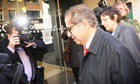
Dr Freddy Patel tells inquest he was asked by police at the postmortem to rule out any assault or crush injuries A senior police officer asked a pathologist whether Ian Tomlinson’s injuries were consistent with a baton strike or a dog bite – four days before video footage emerged showing his encounter with police, the inquest into his death has been told. The pathologist who first examined Ian Tomlinson after he was knocked to the ground by an officer during the G20 protests said he was asked by police at the postmortem to rule out any assault or crush injuries. Dr Freddy Patel told an inquest that police told him that broken bottles and sticks were lying around Tomlinson’s body but there were no police officers “in the immediate vicinity” when he was found. Tomlinson, 47, collapsed and died shortly after being pushed to the ground by PC Simon Harwood. Asked by Alison Hewitt, counsel for the inquest into the newspaper vendor’s death, whether he “was requested by the police to rule out any assault or crush injuries as a result of public order?” Patel replied: “Yes. That’s right.” He was then asked: “Did you have this in mind when you conducted your postmortem examination?” He replied: “That’s correct, yes.” Patel, a consultant forensic pathologist, told the inquest that before the examination began, he had been given “new information” by the police officers involving the crime scene. “It was that he had collapsed outdoors on the pavement, but there was no police officers nearby in the immediate vicinity of the body. There were a lot of broken glass bottles and there were a lot of protesters were using sticks and there were a lot of sticks around the area where it was found.” Patel found Mr Tomlinson’s death was consistent with natural causes because he had coronary artery disease and could have died at any time. But another two pathologists, Dr Nat Cary and Dr Kenneth Shorrock, later carried out their own postmortem examinations and came to a different conclusion, the inquest jury has heard. Cary suggested Tomlinson could have been pushed so he fell with his right arm trapped under his body, hitting his liver and causing it to bleed internally. The inquest heard that four police officers, including Detective Superintendent Tony Crampton, the City of London officer leading the investigation into Tomlinson’s death, had attended the postmortem. During the examination, Crampton asked the pathologist whether his injuries could have been caused by a baton or a dog bite ‚ four days before a video emerged which showed what happened. Patel told the inquest that he had found several injuries on Tomlinson’s legs, including lacerations on his right leg and an elongated bruise on the outside of his left leg. Earlier, the inquest heard evidence from PC Simon Harwood, who struck Tomlinson with his baton on the left leg and pushed him to the ground shortly before he died. Hewitt, counsel to the inquest, asked Patel: “Do you recall Detective Superintendent Crampton asking you whether that injury could have been as a result of a baton strike? “Did you say to him at the time that you could not rule that out but you thought it was more likely to have been as a result of falling against something?” Patel replied: “If I remember correctly, what I said was that, as you say, I can’t rule it out, but it’s in keeping with contact with or from, against a linear object.” Crampton also asked whether puncture wounds on Tomlinson’s right leg might have been caused by a dog bite. Patel told the inquest: “I explained to him that they weren’t typical of a dog bite.” He told the inquest: “Because I was told there were lots of broken bottles there I said it could have been caused by a rugged sharp object.” The inquest heard from Patel that Tomlinson’s postmortem examination was originally scheduled as a “section 19″ or routine, but he had been told that it has been “upgraded” to a “section 20″. Patel said that he may have asked why police were present at the postmortem, which was on 3 April, 2009. “I may have queried why police were attending and I was informed by the coroner’s officer that they would like to rule out whether there was any assault or any crush injuries ‚ and there was a big crowd there – related to the protesters and public order.” Ian Tomlinson Dr Freddy Patel G20 Protest Police London Karen McVeigh guardian.co.uk

 Posted by
on April 12, 2011. Filed under News, Politics, World News.
You can follow any responses to this entry through the RSS 2.0.
You can skip to the end and leave a response. Pinging is currently not allowed.
Posted by
on April 12, 2011. Filed under News, Politics, World News.
You can follow any responses to this entry through the RSS 2.0.
You can skip to the end and leave a response. Pinging is currently not allowed.