‘Outsiders’ blamed for Minsk bomb
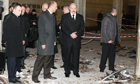
President of Belarus, Alexander Lukashenko, says deadly blast in Minsk metro station was an attempt to destabilize the country President Alexander Lukashenko has said that a blast that tore through a crowded metro station in the Belarus capital Minsk in the evening rush hour, killing 11 people, was an attempt to destabilize the country. As police placed the capital on high alert, Lukashenko linked the explosion to a previous unsolved blast in 2008, saying: “These are perhaps links in a single chain.” “We must find out who gained by undermining peace and stability in the country, who stands behind this,” added the president, whose re-election for a fourth term and subsequent crackdown on protests in December was criticised by western nations. Acts of deliberate violence are unusual in the ex-Soviet republic of 10 million people which shares borders with Poland, Latvia and Lithuania and with Russia and Ukraine. One opposition figure said he feared Lukashenko would use the blast to crack down even more harshly on political rivals. “Prosecutors qualify this as a terrorist act,” a source in Lukashenko’s administration said. Lukashenko said: “I do not rule out that this [the blast] was a gift from abroad.” A former state-farm boss, Lukashenko has ruled Belarus with an iron fist since 1994, jailing opponents and silencng independent media while offering generous welfare and pensions to his citizens on the back of Russian subsidies. After the election, police arrested nearly 700 protesters and reporters during protests. The EU and the US have imposed a travel ban on Lukashenko and his closest associates because of the 19 December crackdown. He has said the opposition rally was an attempted coup financed by the west. The Organisation for Security and Co-operation in Europe (OSCE) monitors said the vote count was flawed and criticised police for being heavy handed. The remarks angered Minsk, which forced the OSCE to close down its office there. In typical combative style, Lukashenko hit back, defending the police, dismissing members of the opposition as being bent on “banditry” and denouncing the OSCE verdict as “amoral”. Monday’s blast occurred on a platform at around 6pm at the Oktyabrskaya metro station – one of the city’s busiest underground rail junctions – about 100m from the main presidential headquarters. Lukashenko was quoted by Interfax news agency as saying 11 people had been killed and 100 injured. A presidential administration source later said 126 people had been injured. In his remarks, Lukashenko referred back to July 2008 when a homemade bomb wounded about 50 people at an open air concert he was attending. The crime was never solved. “Regardless of who organised and ordered the blast, the government will be tempted to use it as an excuse to tighten the screws … I am afraid they will use it,” said Anatoly Lebedko, leader of the opposition United Civic party. Belarus Europe Global terrorism guardian.co.uk

 Posted by
on April 12, 2011. Filed under News, Politics, World News.
You can follow any responses to this entry through the RSS 2.0.
You can skip to the end and leave a response. Pinging is currently not allowed.
Posted by
on April 12, 2011. Filed under News, Politics, World News.
You can follow any responses to this entry through the RSS 2.0.
You can skip to the end and leave a response. Pinging is currently not allowed.