African Union team arrive in Tripoli
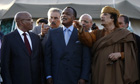
Delegation led by South African president Jacob Zuma may also meet rebel leadership in Benghazi as fighting continues Leaders of five African countries arrived in Tripoli on Sunday to meet Libyan leader Muammar Gaddafi in an attempt to broker a ceasefire and a political resolution to the deadlocked two-month-old conflict. The African Union delegation, led by the South African president, Jacob Zuma, may then fly on to Benghazi, the heartland of the rebels, to press for a diplomatic settlement. The initiative came as Nato air strikes once again pulled the rebels back from the brink of a significant defeat by stalling a government assault on the strategic town of Ajdabiya, the gateway to the revolutionaries’ de facto capital, Benghazi. Air strikes destroyed a total of 25 tanks around Ajdabiya and the besieged western city of Misrata. Nato gave permission for the African leaders’ planes to enter Libyan airspace. The aircraft were the first to land at Tripoli’s Mitiga airport since the international coalition imposed a no-fly zone over the country more than two weeks ago. Several hundred Libyan civilians and military personnel gathered to greet the delegation with an eclectic mix of tribal singing and dancing, bagpipes, brass band and the ubiquitous loyalist chant of ” Allah, Muammar, Libya wa bas [that's all we need]“. Zuma, who arrived aboard a South African air force plane, made no comment before leaving in an armoured convoy. Earlier, a statement from the African Union delegation said its objective was to bring military operations in Libya to an end and to mediate between the regime and the opposition on a political resolution. “We hope that mediation will lead to a constructive dialogue for a political settlement of the crisis based on the aspirations of the Libyan people,” said the Mauritanian president, Mohamed Ould Abdel Aziz. The other members of the team are the presidents of Congo-Brazzaville and Mali and the Ugandan foriegn minister. The African Union initiative follows a proposal last week by the Turkish prime minister, Recep Tayyip Erdogan, for a three-point plan covering a ceasefire, political negotiations and a humanitarian corridor. However, opposition forces insist they will not consider any political deal that involves Gaddafi or members of his family retaining power. Proposals put forward by the regime so far have included Gaddafi or one of his sons overseeing political change in Libya. It is far from clear how this gap could be bridged. Nato said its forces destroyed 11 tanks around Ajdabiya and 14 tanks on the outskirts of Misrata, the sole rebel-dominated town in the west of the country, host to fierce fighting for about six weeks. “The situation in Ajdabiya and Misrata in particular is desperate for those Libyans who are being brutally shelled by the [Gaddafi] regime,” said Lieutenant General Charles Bouchard, the Canadian commander of Nato’s Libya operations. A Red Cross ship docked in Misrata at the weekend, bringing medical supplies to civilians in the besieged port city, about 100 miles from Tripoli. The Libyan government has refused to take journalists based in the capital into Misrata, citing safety reasons, but civilians and doctors by phone have described coming under attack from shelling and sniper fire. Many of the victims are reported to be children. Last week, Nato said Misrata was its “number one priority”. The air strikes on Ajdabiya, 90 miles from Benghazi, helped reverse days of setbacks for the rebels which saw Gaddafi’s forces fight their way in to the heart of the town on Saturday. Shelling around the southern entrance to Ajdabiya could be heard on Sunday morning but it died away in the afternoon following the air strikes. Among the vehicles hit were six carrying government soldiers. Their charred bodies were scattered around the still burning vehicles a few hours later. “Nato has to do this to help us every single day. That is the only way we are going to win this war,” a 25-year-old rebel, Tarek Obeidy, told Reuters while standing over the bodies. The rebels said government forces shot down a Russian-made helicopter sent into the fight by the rebels two days earlier. Nato forced a MiG jet fighting for the rebels to land because of the UN-imposed no-fly zone. Many areas were deserted after civilians fled the prospect of Gaddafi’s troops taking it for a second time in as many weeks. Thousands of rounds of discarded bullet casings marked the site of some of the most intense fighting over the weekend. The sudden change in the rebels’ fortunes once again demonstrated how reliant they are on Nato air strikes to hold off government assaults. Nato faced humiliation if Gaddafi’s army forced its way through Ajdabiya once again and threatened Benghazi, the city the western allies launched the first air strikes to defend. Rebel defences around Benghazi are little in evidence, other than a line of artillery about 15 miles from the city. Libyan officials said that the regime was preparing a new constitution, although failed to give details or say whether Gaddafi would retain power. One official, Ibrahim Moukhzam, said: “Constitutions are not designed to fit around individuals. They are designed to serve the nation and any citizen can find a place for them in this constitution. “Muammar Gaddafi as a Libyan individual can find his place in the constitution. The vast majority of people want him to stay. He is a symbol. He has many jobs and tasks.” Asked if it would be a presidential republic or another political system, Moukhzam said it would be a “Libyan version”. Gaddafi made his first public appearance in several days at the weekend, visiting a school in Tripoli where he was greeted by chanting and ululating supporters. Meanwhile, three western journalists are believed to be in the custody of the regime after being detained by government forces near Brega, in the east of the country, last week. A photographer for the Associated Press, who was missing after becoming separated from colleagues near Ajdabiya on Saturday, has been found. Libya Middle East Arab and Middle East unrest African Union Jacob Zuma Nato Muammar Gaddafi Harriet Sherwood Chris McGreal guardian.co.uk

 Posted by
on April 10, 2011. Filed under News, Politics, World News.
You can follow any responses to this entry through the RSS 2.0.
You can skip to the end and leave a response. Pinging is currently not allowed.
Posted by
on April 10, 2011. Filed under News, Politics, World News.
You can follow any responses to this entry through the RSS 2.0.
You can skip to the end and leave a response. Pinging is currently not allowed.