Ian Tomlinson inquest: live coverage
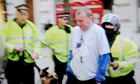
Full coverage as the inquest hears a third day of evidence from PC Simon Harwood, the police officer who struck Tomlinson at the G20 protests moments before he died 10.54am: We’re now being shown another piece footage, from a few seconds later, at the other end of Royal Exchange Buildings passage (near Threadneadle Street). This Google map shows the scene. A man comes into frame who (off camera) Harwood has said demanded to get through a police cordon with clenched fists. The man is in a beige trench coat and I think is wearing glasses. He looks like a City worker. Previously, Harwood said he pushed the man with an open palm strike. Ryder : “Did you baton him?” Harwood : “I have never suggested I did, no.” Ryder : “So you pushed him first and didn’t need to baton him, is that right?” Harwood : “I didn’t find a need to baton him.” Ryder: “Because you pushed him first and he had moved?” Harwood : “Yes.” Ryder : “And this is a man facing you with clenched fists saying he wants to go in the precise direction that you say he can’t go?” Harwood : “Yes.” Ryder : “And you push him, and he goes in the other direction?” Harwood : “Defensive strike to the shoulder, yes.” 10.44am: Another exchange: Ryder : “I’m going to suggest to you, PC Harwood, that you are deliberately being evasive here and that you are deliberately not facing up to what is happening in the video.” Harwood : “No, I’m not being evasive.” 10.43am: The footage appears to show Falshaw being pulled and falling backwards on to the ground. Harwood repeatedly denies having pulled the cameraman from behind and, when offered the chance to see the video again, replies: “No.” 10.39am: Another clip, showing Harwood clashing with BBC cameraman Tony Falshaw. The inquest has already heard that Falshaw said he was pulled to the ground. Ryder : “You took hold of him and pulled him to the floor, didn’t you? Harwood : “No.” Ryder : “Do you agree you pulled him to the floor?” Harwood : “From seeing the video evidence I agree I grabbed his, I believe, left arm.” Ryder : “And pulled him to the floor.” Harwood : “No, I pulled him away from myself.” Asked by Ryder if he was “shocked” the cameraman fell to the ground, Harwood said he could “not recall”. 10.32am: Another video clip. After being beckoned away from a wall by Harwood, an officer in a flat cap gets punched by a protester. Harwood said of his attempt to get the other officers to follow him: “At the time, I was trying to make all the officers make a cordon with me across that junction.” 10.29am: The video clip then shows Harwood gesturing to other officers to walk up the street. He tells the jury he was seeking to form a protective “cordon” around the corner with other officers. He said he did not know how many other officers were around the corner. The officers in the frame did not initially follow him. 10.25am: Another piece of footage – shot just after 19.14pm. PC Harwood joins another officer by the Royal Exchange Buildings. There is a protester blowing a toy trumpet near an officer. The second officer does not react, but Harwood, joining the officer, flicks his jacket at the protester. At one stage Harwood is asked if he wants to see the footage again. He replies: “No thank you.” 10.20am: Fair exchanges are as frosty as they were yesterday. Ryder has asked for video footage showing the crowd at the time he made his attempted arrest. Ryder says the footage shows that Harwood’s carrier was “the safest place you could be at that time” (after the arrest), and points out that his colleague, PC Hayes, was able to return to his van. 10.14am: Matthew Ryder, counsel for Tomlinson’s family, has taken off from where we left yesterday – shortly after Harwood tried to arrest a protester he found spraying graffiti on a colleague’s van. If you recall, Harwood said he was in fear of his life and unable to return to his carrier. 10.06am: There are a couple of delays, so just before we get started, let me respond to a question from a reader, who asks why the prose-heavy live-blog looks different to blogs we use to cover breaking news stories. Six months ago, journalists were not allowed to send text messages from a courtrooms, let alone use laptops. That changed in December when the Times journalist Alexi Mostrous was granted permission by a district judge to tweet from a Julian Assange extradition hearing. The lord chief justice then released interim guidance which provided judges with the discretion to permit journalists to use “live text based communication” in courtrooms. There is an official consultation ongoing to decide a more permanent set of rules on broadcasting information from inside court, and that explains why – given there is a jury – I am required to be more cautious. Twitter has been used extensively by journalists in courts in recent months, with mixed reviews. I haven’t seen any live-blogs written from inside an inquest courtroom yet, so to a degree we are experimenting. 10.04am: The jury has entered the room – we’re about to start. 9.55am: I’ve had some questions about the venue. We’re at the International Dispute Resolution Centre at 70 Fleet Street. Inquests are often held in odd places, and it was hard for the coroner to find a space big enough within the Square Mile. This is it. It’s sunny outside, but we’re in a room with close blinds and artificial light. The set-up here is professional. As a hack you get used to our creaking and opaque courts system. This is maybe a taste of how things should be. The inquest has its own website, where transcripts of evidence are uploaded onto the website each evening , a helpful press team and a fridge full of water. We had biscuits and coffee too, until they disappeared. (Austerity cuts?) 9.50am: Good morning. We will shortly begin the third day of evidence from PC Simon Harwood, the police officer who struck Ian Tomlinson at the G20 protests moments before he died. If yesterday’s proceedings are anything to go by, we could have some more gripping exchanges. Here is a quick recap of Harwood’s previous two appearances this week: Monday: Harwood made his first appearance at the inquest into Ian Tomlinson’s death . His opening remarks, in which he said he hoped to “help” the family, caused some offence. Most of his evidence concentrated on the minutes leading up to his encounter with Tomlinson. The officer described trying to arrest a protester he caught daubing graffiti on a van, saying the angry reaction from the crowd left him “in fear of my life”. Earlier in the day, Harwood’s senior officer, Inspector Timothy Williams, revealed he tried to persuade the van driver he could not possibly be the officer in the footage after hearing a rumour that another officer, based in Hackney, had been identified. Tuesday: Harwood gave his first account of his use of force against Tomlinson . He said he struck him with a baton and pushed him in the back to “encourage” him to move away from a police line, adding that he was “amazed” when the father of nine fell to the ground. However, he conceded Tomlinson was “no threat” to him or anyone else, and offered a partial apology. The day ended with Harwood undergoing a grilling from the barrister representing Tomlinson’s family and, in one of the last exchanges of the day, the police officer admitted some of his account of the day had been incorrect. Ian Tomlinson Police London G20 Protest Paul Lewis Sam Jones guardian.co.uk

 Posted by
on April 6, 2011. Filed under News, Politics, World News.
You can follow any responses to this entry through the RSS 2.0.
You can skip to the end and leave a response. Pinging is currently not allowed.
Posted by
on April 6, 2011. Filed under News, Politics, World News.
You can follow any responses to this entry through the RSS 2.0.
You can skip to the end and leave a response. Pinging is currently not allowed.