Libyan defector not offered immunity, says Hague
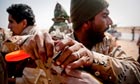
• Libyan foreign minister flees to Britain • Obama authorises covert action in Libya • US hands over operations to Nato • Loyalists push further east 11.19am: The Guardian has been told that General Khouildi Hamidi, Muammar Gaddafi’s intelligence coordinator, is defecting from the Gaddafi regime. We’re trying to confirm this. 10.55am: Worrying reports from Bahrain that the prominent blogger Mahmood al-Yousif has been arrested in the country. The Guardian has just spoken to Mahmood’s brother, Hani, who said police turned up at Mahmood’s house outside Manama at 3am on Wednesday morning with a warrant for his arrest. The al-Yousif family have since not heard anything from Mahmood since he was permitted one phone call to his son on Wednesday morning. Hani, who has lived in the UK for the past 16 years, said that only Mahmood, 50, and his 17-year-old son Arif were in the house at the time of the arrest. Mahmood’s wife, who is Scottish, is in Scotland at the moment, while he has two daughters who are studying in Vancouver. Hani, 42, said Mahmood tweeted just before his arrest “the police are here for me”, but said that post, and several other tweets were deleted after Mahmood had been detained. Hani told the Guardian that Arif, who witnessed his father’s arrest, said police had taken all Mahmood’s computer equipment after the arrest. The most recent tweets on the blogger’s @mahmood twitter account all appear to have been automatically generated, with the last ‘real’ tweet apparently sent on 28 March . Hani said from his knowledge of other bloggers’ travails with security forces in Bahrain writers are usually arrested and then released. “But the family are worried, because we’ve not heard anything,” Hani said. You can read Mahmood’s blog – Mahmood’s Den – here . 10.45am: Our politics live blogger Andrew Sparrow is following the foreign secretary’s speech : Hague says he is launching the Foreign Office report on human rights. The full report is now on the Foreign Office website . The government promised a foreign policy that would have support for human rights and poverty reduction at its core, he says. Support for human rights “is part of our national DNA”. The Libyan people have suffered serious human rights abuses for decades. Their plight is now worse than ever, he says. Britain and its allies have intervened in Libya to save lives. It is action that is “legal, necessary and right”. Hague says Moussa Koussa travelled to the UK under his own free will. The government will release further details later. He is one of the most senior members of the regime. His resignation shows that Colonel Gaddafi’s regime is “fragmented, under pressure and crumbling from within”. • Moussa Koussa is not being offered any immunity from prosecution, Hague says. 10.39am: William Hague is speaking at the Foreign Office. He’s expected to give more details on Moussa Koussa’s defection. We’ll follow it live here. 10.21am: The Belgian newspaper De Standaard has posted footage of Belgian F-16 fighter jets in action. This video shows one jet bombing a (grounded) Libyan plane. Hat-tip to LibyaFeb17.com for the link. 10.12am: CNN has interviewed the mother of Iman al-Obeidi, the 29-year-old Libyan woman who said she was raped by Gaddafi militia. “If I were to see his face, I would strangle him (Gaddafi),” Aishah Ahmad told CNN in an interview at her home in the eastern coastal city of Tobruk. 10.05am: The BBC live blog has come across this blog written by regime spokesman Musa ibrahim’s German-born wife, Julia Ramelow. She wrote on 14 March. I’m not sure what to write really. I am stunned by the atrocities I have seen committed by these so-called rebels. Hangings. Beheadings. Immolations – and then they pulled out the heart and stamped on it. Is that what they want Libya to become? 9.50am: More evidence of mounting international pressure on Gaddafi. His regime has been ordered to appear before Africa’s highest court to face charges of “massive violations of human rights” for killing peaceful demonstrators, in a story Owen Bowcott and Maya Wolfe-Robinson had last night . The announcement from the African court on human and peoples’ rights in Arusha, Tanzania, is likely to be welcomed by the Nato coalition as a significant sign of international support. The “order for provisional measures” issued by the court unanimously declares that the “government of the Great Socialist People’s Libyan Arab Jamahiriya” must immediately refrain from any action that would result in loss of life or breach human rights. It also summons the Tripoli regime to appear before the court within 15 days to explain what measures have been taken to implement the order. 9.40am: Nato is now officially in command of all air operations over Libya, having taken over from the US. The alliance took charge at 6am GMT this morning. The operation, codenamed Unified Protector, includes includes enforcement of the no-fly zone, maintaining the arms embargo on Libya, and the protection of civilians. The handover came after some fractious haggling , with the French reluctant to move to a structure that it feared would hamper its capacity for action. Turkey, a Nato member, wanted to clip France’s wings. 9.28am: Jack Straw, the former foreign secretary, told BBC Radio 4′s Today programme that Kousa’s defection could be a tipping point. From a distance, what’s clear is that there is unlikely to be any military ‘victory’ for either side. So it does depend on which side psychologically collapses. I don’t think the rebels are going to, and nobody wants them to, so it is about boring your way inside the brain and heart of the regime. There is a tipping point with all of these regimes and I think Musa Kusa’s apparent defection – certainly his unscheduled visit here – will be a very important factor in just adding to the weight against the Gaddafi regime and tipping the balance against him. 9.22am: Chris McGreal, who is in Benghazi, tells us that Gaddafi has taken a leaf out of the rebels’ book, copying their tactics and putting them to effective use. He seems to have adopted the rebel tactics of using pick-up trucks with machine guns mounted on the back. Highly mobile, much faster than using heavy armour, they’re able to sweep through the desert and around the rebels. Not only is he copying what the rebels are doing, he is doing it much better in the sense that he has much more disciplined troops. Chris also thinks giving the rebels more weapons won’t do much good as they lack training or the tactical nous. Those weapons might even fall into the hands of Gaddafi’s troops and turned against them. 8.50am: This Observer article in 2003 underlines Mousa’s importance in bringing Libya in from the cold and has good background on Mousa’s earlier radicalism. Kousa first came to notoriety in 1979 when he became head of the Libyan mission and de facto Libyan ambassador to Britain, delivering an astonishing interview to Times journalist Michael Horsnall in 1980 that amounted to an announcement of intent to commit murder. 8.41am: Vivienne Walt at Time magazine has a typically thorough piece on the importance of Kousa’s defection. Kusa was a long-standing chief of Libya’s intelligence service, before being appointed Foreign Minister in 2009. That means he likely holds critical information which could ultimately lead to international indictments against Gaddafi and his family, including whether the Libyan leader ordered the Pan Am jet to be shot down over Lockerbie, Scotland in 1989, an attack which killed 270 people. She also points out that Kousa was a central figure in helping to negotiate Libya’s detente with the US in 2003. Along with Saif al-Islam (one of Gaddafi’s sons), he persuaded Gaddafi to abandon his pursuit of weapons of mass destruction, and opted to share intelligence information with the US on al-Qaida operatives in Libya. It was Kusa’s sharp instincts which in fact led to the drastic change in Libya’s political international standing in 2003. 8.23am: It seemed inevitable that tales of CIA skullduggery in Libya would emerge sooner or later. Sure enough, it’s all over the US papers today after Reuters broke the story . Both the New York Times and the Washington Post report on the presence of CIA operatives to gather information about the rebels. Both say that Obama signed a secret order several weeks ago authorising the CIA to carry out a clandestine effort to provide arms and other support to Libyan opposition groups. The New York Times says in addition to the CIA presence, dozens of British special forces and MI6 intelligence officers are working inside Libya. US officials told the Times that British forces have have been directing air strikes from British jets and gathering intelligence about the whereabouts of Libyan government tank columns, artillery pieces and missile installations. More from the Times. In recent weeks, the American military has been monitoring Libyan troops with U-2 spy planes and a high-altitude Global Hawk drone, as well as a special aircraft, JSTARS, that tracks the movements of large groups of troops. Military officials said that the Air Force also has Predator drones, similar to those now operating in Afghanistan, in reserve. Air Force RC-135 Rivet Joint eavesdropping planes intercept communications from Libyan commanders and troops and relay that information to the Global Hawk, which zooms in on the location of armored forces and determines rough coordinates. The Global Hawk sends the coordinates to analysts at a ground station, who pass the information to command centres for targeting. The command center beams the coordinates to an E-3 Sentry Awacs command-and-control plane, which in turn directs war planes to their targets. The Washington Post notes that such operations are risky. The CIA’s history is replete with efforts that backfired against US interests in unexpected ways. In perhaps the most fateful example, the CIA’s backing of Islamic fighters in Afghanistan succeeded in driving out the Soviets in the 1980s, but it also presaged the emergence of militant groups, including al-Qaida, that the United States is now struggling to contain. Gaddafi can be expected to exploit these reports for maximum propaganda and to try to tar the rebels as “imperialist stooges”. 8.00am: Diplomatically, Muammar Gaddafi suffered a blow as his foreign minister and close adviser, Mousa Kousa, fled to Britain on a specially arranged flight organised by the British intelligence services. Gaddafi’s justice and interior ministers resigned shortly after the uprising began last month, but Kousa is the first high-profile resignation since the international air campaign began. Kousa’s decision to abandon the regime came as it emerged that Barack Obama had signed a secret government order authorising covert US help to the Libyan rebels via such organisations as the CIA. The order, known as a “finding” was signed within the last two or three weeks. The move will undoubtedly fuel speculation that the US and its allies are planning to arm the rebels. On the ground, Gaddafi’s forces have recaptured much of the ground they lost at the weekend, pushing the disorganised rebels out of the important oil towns of Ras Lanuf and Brega. The regime’s counterattack has outmaneouvred the poorly disciplined and untrained rebels. They barely made a stand at Brega before turning and fleeing toward Ajdabiya, 100 miles south of Benghazi. If the government were to move on Ajdabiya, the road to Benghazi, the rebel stronghold would be open again. • Libyans could face deadlock as both sides run low on arms . • Libyan and Middle East unrest as it unfolded yesterday. • Interactive: Gaddafi forces push rebels back. Libya Arab and Middle East unrest Syria Yemen Bahrain Middle East Mark Tran Adam Gabbatt guardian.co.uk

 Posted by
on March 31, 2011. Filed under News, Politics, World News.
You can follow any responses to this entry through the RSS 2.0.
You can skip to the end and leave a response. Pinging is currently not allowed.
Posted by
on March 31, 2011. Filed under News, Politics, World News.
You can follow any responses to this entry through the RSS 2.0.
You can skip to the end and leave a response. Pinging is currently not allowed.